The banquet of Dun na n-Gedh : and the battle of Magh Rath : an ancient historical tale now first published from a manuscript in the Library of Trinity College, Dublin / with a translation and notes by John O'Donovan.
- Date:
- 1842
Licence: Public Domain Mark
Credit: The banquet of Dun na n-Gedh : and the battle of Magh Rath : an ancient historical tale now first published from a manuscript in the Library of Trinity College, Dublin / with a translation and notes by John O'Donovan. Source: Wellcome Collection.
375/410 (page 331)
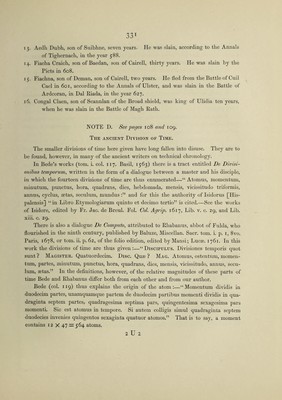
![13- Aedh Dubh, son of Suibhne, seven years. He was slain, according to the Annals of Tighernacli, in the year 588. 14. Fiacha Craich, son of Baedan, son of Cairell, thirty years. He was slain by the Piets in 608. 15. Fiachna, son of Deman, son of Cairell, two years. He fled from the Battle of Cuil Cael in 601, according to the Annals of Ulster, and was slain in the Battle of Ardcoran, in Dal Riada, in the year 627. 16. Congal Claen, son of Scannlan of the Broad shield, was king of Ulidia ten years, when he was slain in the Battle of Magh Rath. NOTE D. See pages 108 and 109. The ancient Division of Time. The smaller divisions of time here given have long fallen into disuse. They are to be found, however, in many of the ancient writers on technical chronology. In Bede’s works (tom. i. col. 117. Basil, 1563) there is a tract entitled De Divisi- onibus temporum, written in the form of a dialogue between a master and his disciple, in which the fourteen divisions of time are thus enumerated—“ Atomus, momentum, minutum, punctus, hora, quadrans, dies, hebdomada, mensis, vicissitudo triformis, annus, cyclus, aetas, seculum, mundusand for this the authority of Isidorus [His- palensis] “in Libro Etymologiarum quin to et decimo tertio” is cited.—See the works of Isidore, edited by Fr. Jac. de Breul. Fol. Col. Agrip. 1617, Lib. v. c. 29, and Lib. xiii. c. 29. There is also a dialogue De Computo, attributed to Rhabanus, abbot of Fulda, who flourished in the ninth century, published by Baluze, Miscellan. Sacr. tom. i. p. 1, 8vo. Paris, 1678, or tom. ii. p. 62, of the folio edition, edited by Mansi; Lucie. 1761. In this work the divisions of time are thus given :—“ Discipulus. Divisiones temporis quot sunt ? Magister. Quatuordecim. Disc. Quae ? Mag. Atomus, ostentum, momen- tum, partes, minutum, punctus, hora, quadrans, dies, mensis, vicissitudo, annus, secu- lum, aetas.” In the definitions, however, of the relative magnitudes of these parts of time Bede and Rhabanus differ both from each other and from our author. Bede (col. 119) thus explains the origin of the atom:—“Momentum dividis in duodecim partes, unamquamque partem de duodecim partibus momenti dividis in qua- draginta septem partes, quadragesima septima pars, quingentesima sexagesima pars momenti. Sic est atomus in tempore. Si autem colligis simul quadraginta septem duodecies invenies quingentos sexaginta quatuor atomos.” That is to say, a moment contains 12 X 47 = 564 atoms. 2 U 2](https://iiif.wellcomecollection.org/image/b28754232_0375.jp2/full/800%2C/0/default.jpg)