The banquet of Dun na n-Gedh : and the battle of Magh Rath : an ancient historical tale now first published from a manuscript in the Library of Trinity College, Dublin / with a translation and notes by John O'Donovan.
- Date:
- 1842
Licence: Public Domain Mark
Credit: The banquet of Dun na n-Gedh : and the battle of Magh Rath : an ancient historical tale now first published from a manuscript in the Library of Trinity College, Dublin / with a translation and notes by John O'Donovan. Source: Wellcome Collection.
50/410 (page 6)
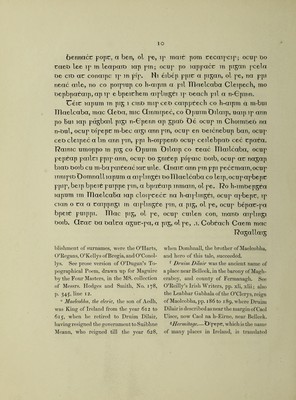
![Qeóa, rnioppo, o po ^ab pije Gpenn ba peaD a Dun-apup corn- mnóce do poejae Gpenn cécup Dun rta n-^eD po]i bpu na boinne. Ocup po copamD piuin pecc rrmpu niop-ambli írrion Dún pin pa copmailiup Uempaij na pi£, ocup pó ropainD 51D ci^e m Dúme pin pa copmailiup cige na Uempac .1. m nnDcuaipc mop-aobal, íp mci no biD in pig pepm ocup na pí^na ocup na h-ollumain, ocup an ip Deach ppi cec n-DÓrn olcena; ocup m Con^ Ilium an, ocup m bort^ Cai^en, ocup in Chorpip Connacr, ocup m Gacpaip Ulao, ocnp Capcaip na n-giall, ocup l?ecla na pileD, ocu]' ^pianan m en uairne,—ip epiDe Do pi^neD la Copmac mac Qipc ap cnp Dia íngin .1. Do ^jpaine—ocnp na ri^e olce of Galway. But the monarch of Ireland, of whatever race he happened to be, or wherever he fixed his residence, was ne- vertheless called King of Tara as often as King of Erin by the Bards. g Dun na n-gedh.—This name is now forgotten. It was probably the name of the large fort on the south side of the Boyne, near Dowtli, in the county of East Meath. In Mac Morissy’s copy it is written Dun na n-gaedh, which seems more cor- rect. King Domhnall afterwards removed his residence to Ard Fothadh, near the town of Donegal, where he died, according to the Annals of the Four Masters, in the year 639 \_recte 642]. h Midhchuairt.—For an account of the Teach Midhchuarta, or Banqueting Hall at Tara, see Petrie’s History and Antiqui- ties of Tara Hill, p. 160, et sequent. 1 Ollaves—Ollamh signifies a chief pro- fessor of any science. 1 Long Mumhan, — i. e. the Munster a cenmorac pm. Coolaip house. k Long Laighean,—i. e. the Leinster house. 1 Coisir Connacht,—i. e. the Connaght Banqueting house. m Eachrais Uladh,—i. e. the Ultonian house. These four houses seem to have formed a part of the Teach Midhchuarta. n Prison of the Hostages—For the situ- ation of Durnha na n-giall, at Tara, near which must have stood Carcair na n-giall, the Prison of the Hostages, see Petrie’s Hist, and Antiq. of Tara Hill, plate 7. 0 Star of the Poets There is no men- tion made of this house in Petrie’s History and Antiquities of Tara Hill. p Grianan of the one pillar.—This is the fort called Bath Graine, in Petrie’s His- tory and Antiquities of Tara Hill, p. 192. The relative situation of all the ruins, as existing on Tara Hill, in the tenth century, are shown on plate 10 of that work, and as they exist at present on plate 6, and](https://iiif.wellcomecollection.org/image/b28754232_0050.jp2/full/800%2C/0/default.jpg)