The banquet of Dun na n-Gedh : and the battle of Magh Rath : an ancient historical tale now first published from a manuscript in the Library of Trinity College, Dublin / with a translation and notes by John O'Donovan.
- Date:
- 1842
Licence: Public Domain Mark
Credit: The banquet of Dun na n-Gedh : and the battle of Magh Rath : an ancient historical tale now first published from a manuscript in the Library of Trinity College, Dublin / with a translation and notes by John O'Donovan. Source: Wellcome Collection.
61/410 (page 17)
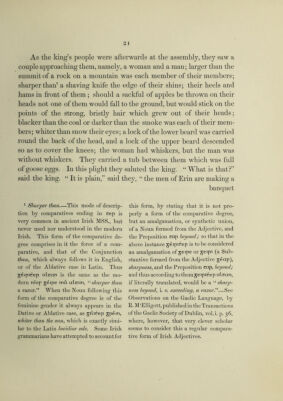
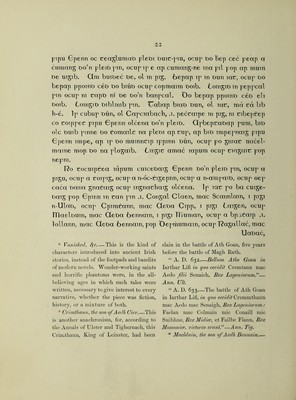
![thronek. There was not in Erin a fort like his fort, but neither the Queen, nor Domhnall himself, deemed the sound of the name by which it was called melodious, viz., Dun na n-Gedh1. And Domhnall com- manded his stewards and lawgivers, and the collectors of his rents and tributes, to gather and bring to the feast all the goose eggs that could be found in Erin, for Domhnall did not deem it honourable that there should be in Erin a kind of food that should not be found at that banquet; and all the materials were collected for the feast, wine, metheglin, and ale, and every kind of food besides, except the eggs alone, for it was not easy to procure them1. And the collectors went forth throughout Meath, in search of the eggs, until they came to a small Duirtheach11 [hermitage], in which was one woman0 with a black hoodp upon her head, and she praying to God. The king’s people saw a flock of geese at the door of the Duirtheach; they went into the house and found a vessel full of goose eggs. “ We have had great success,” said they, “ for should we search Erin, there could not be found more goose eggs together in one place than are here.” “ It will not be good success,” said the woman, “ and it will not redound lege, Dublin, that the Duirtheach was the smallest of the sacred edifices in use amongst the ancient Irish. See the pas- sage given in full in the second part of Mr. Petrie’s Inquiry into the Origin and Uses of the Round Towers of Ireland, where the meaning of the word is dis- cussed at full length. The site of the Duirtheach above re- ferred to, which is on the margin of the Boyne, near the village of Slane, in the county of East Meath, is now occupied by a small chapel in ruins, which, though only a few centuries old, is still called IRISH ARCH. SOC. 6. \ Erc’s Hermitage. ° One woman.—The word bannpcal, which is also written banpjal, is now ob- solete, but it occurs so frequently in the ancient MSS. that its meaning cannot be mistaken. It is always used to denote female or icoman, as is peppcal to denote male or man. “ lp cpia buripjal camic báp oo’n bic, i. e. it is through, or on ac- count of, a woman, death entered into the world.”—Leabhar Breac. p With a black hood.—The word caille is evidently cognate with the English word cowl. It is translated velum by Col-](https://iiif.wellcomecollection.org/image/b28754232_0061.jp2/full/800%2C/0/default.jpg)