The banquet of Dun na n-Gedh : and the battle of Magh Rath : an ancient historical tale now first published from a manuscript in the Library of Trinity College, Dublin / with a translation and notes by John O'Donovan.
- Date:
- 1842
Licence: Public Domain Mark
Credit: The banquet of Dun na n-Gedh : and the battle of Magh Rath : an ancient historical tale now first published from a manuscript in the Library of Trinity College, Dublin / with a translation and notes by John O'Donovan. Source: Wellcome Collection.
63/410 (page 19)
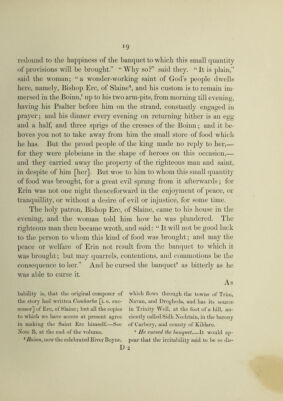
![redound to the happiness of the banquet to which this small quantity of provisions will be brought.” “Why so?” said they. “It is plain,” said the woman; “ a wonder-working saint of God’s people dwells here, namely, Bishop Ere, of Slaineq, and his custom is to remain im- mersed in the Boinn,r up to his two arm-pits, from morning till evening, having his Psalter before him on the strand, constantly engaged in prayer; and his dinner every evening on returning hither is an egg and a half, and three sprigs of the cresses of the Boinn; and it be- hoves you not to take away from him the small store of food which he has. But the proud people of the king made no reply to her,— for they were plebeians in the shape of heroes on this occasion,— and they carried away the property of the righteous man and saint, in despite of him [her]. But woe to him to whom this small quantity of food was brought, for a great evil sprang from it afterwards; for Erin was not one night thenceforward in the enjoyment of peace, or tranquillity, or without a desire of evil or injustice, for some time. The holy patron, Bishop Ere, of Slaine, came to his house in the evening, and the woman told him how he was plundered. The righteous man then became wroth, and said: “ It will not be good luck to the person to whom this kind of food was brought; and may the peace or welfare of Erin not result from the banquet to which it was brought; but may quarrels, contentions, and commotions be the consequence to her.” And he cursed the banquets as bitterly as lie was able to curse it. As bability is, that the original composer of which flows through the towns of Trim, the story had written Comhurba [i. e. sue- Navan, and Drogheda, and has its source cessor] of Ere, of Slaine; but all the copies in Trinity Well, at the foot of a hill, an- to which we have access at present agree ciently called Sidli Nechtain, in the barony in making the Saint Ere himself.—See of Carbery, and county of Kildare. Note B, at the end of the volume. s He cursed the banquet It would ap- x Boinn, now the celebrated River Boyne, pear that the irritability said to be so dis- D 2](https://iiif.wellcomecollection.org/image/b28754232_0063.jp2/full/800%2C/0/default.jpg)