On the earthworms collected during the 'Skeat expedition' to the Malay peninsula, 1899-1900 / by Frank E. Beddard.
- Frank Evers Beddard
- Date:
- 1900
Licence: In copyright
Credit: On the earthworms collected during the 'Skeat expedition' to the Malay peninsula, 1899-1900 / by Frank E. Beddard. Source: Wellcome Collection.
Provider: This material has been provided by The Royal College of Surgeons of England. The original may be consulted at The Royal College of Surgeons of England.
20/24 page 908
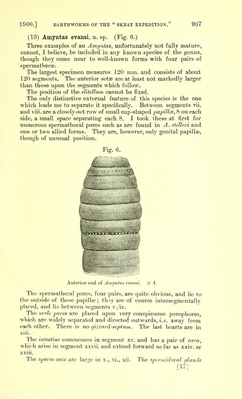
![(defective on the right side of one specimen) occupy segments xvii.-xix.; they aie lobate and have but a short duct. The spennatheccB (in vi.-ix.) have a diverticulum which is very short. Hah. Biserat. We may thus define the species :— Amyntas evansi, ii. sp. Length 120 mm.; number of segments 120. Anterior setae not larger than those upon following segments. Clitelhim ? Geoital papillae 8 pairs on intersegmental groove vii./viii. Male pores far apart. Gizzard-septum absent. Caeca present. Last heart in xiii. Sperm-sacs in x., xi., xii. Spermiducal glands xvii.- xix., with short duct and no terminal sac. Spermathecae in vi.-ix., with short diverticulum. Hah. Malay Peninsula. (14) Amyntas biporus, n. sp. (Fig. 7, p. 910.) Of this species I have been able to examine a large number of individuals. They are all of moderate size. The length is fairly illustrated by a specimen which measured 115 mm. and consisted of 93 segments. The setce are a trifle stouter upon the anterior segments of the body; they are particularly small upon the xth and, though the difference is less marked, upon the xitii segment. The xth segment, as is so often the case, is larger than the others. The clitelhim completely occupies its usual segments. I found setse upon all of its three segments. Genital papUhe are found both anteriorly and posteriorly ; in nearly all of the specimens which I examined there are a pair of papillae upon the viith segnaent, lying just behind the circle of setae; these are not large and have an elliptical contour ; they are almost eye-like in form. In one specimen there were, in addition to these, an exactly similar pair of papillae lying on the viiith segment, but in front of the circle of setae and rather near to each other in the median line. In another worm the right-hand one only of the additional pair of papillae w'as present. As the great majority of the specimens had but the single pair of papillae on segment vii., that may be regarded perhaps as the normal arrangement for the species. The posterior pair of papillae are upon the xixth segment, and they showed no variations at all ; there was alwmys one pair and one only. The curious fact about these papillae is that they are exactly like the male pores which precede them. It wmuld be quite impossible from an examination of the external characters of the w’orm alone to say definitely which w^as male pore and which papilla. Indeed the opinion arrived at would probably be that this species possessed two pairs of male pores. The first specimen that [ examined was put down by me as an abnormality until the examination of others showed that it was a constant character. It [IS]](https://iiif.wellcomecollection.org/image/b22406475_0022.jp2/full/800%2C/0/default.jpg)