The evidence taken before a committee of the House of Commons respecting the asylum at York : with observations and notes, and a letter to the committee &c. &c. &c. / by Godfrey Higgins.
- Godfrey Higgins
- Date:
- 1816
Licence: Public Domain Mark
Credit: The evidence taken before a committee of the House of Commons respecting the asylum at York : with observations and notes, and a letter to the committee &c. &c. &c. / by Godfrey Higgins. Source: Wellcome Collection.
Provider: This material has been provided by the Francis A. Countway Library of Medicine, through the Medical Heritage Library. The original may be consulted at the Francis A. Countway Library of Medicine, Harvard Medical School.
57/94 page 47
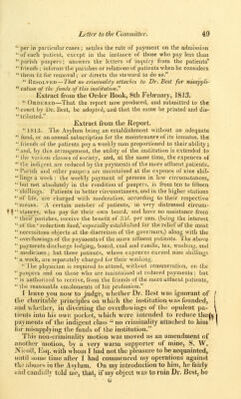
![Retreat, nearly as four to one. Will another epidemic be ready- to account for this ? At first sio^ht, this may appear to reflect on the professional characters of the medical officers of the institution : with that I really believe it has no connexion. The real conv iction in my mind is, that Dr. Best, in order that he might be able to say that his house was conducted on as lenient a plan as the Retreat, had ordered all chains to be disused; but had neglected, in lieu thereof, to adopt any increased vigilance or mild contrivances, such as the Quakers use, to prevent the patients from injuring each other; and that, in fact, they killed one another. Tliis, I have no doubt, was one of the causes of the mortality. The case of Chappey, a pauper, (allucied to in p. 7,) is a strong ex- ample of this kind. He was shut in a room for the night, when in a state of great violence, and in a strait waistcoat, with three other lunatics, an iron fender and two pewter chamber-pots being left loose amongst tliem; and, before morning, he was so bruised that he died the following day. At this time, the Com- mittee of General Inquiry was sitting almost daily. Immedi- ately on his death, as if nothing unusual had happened, he was put into a coffin, and sent to his friends in York to be interred. But the Rev. Mr. Graham, suspecting something wrong, would not bury him without a coroner's inquest, which returned a ver- dict, that he had died from the violence of the other patients. • He was entered in the books, as usual, died; and, if it had not been for this troublesome clergy man, the epidemic would have borne the blame. How many similar accidents happened, it is impossible to know, as the mode of entering all, died or removed,'^ effec- tually disguised the facts both from the Governors and t]i6 public. After I had produced the fact of the mortality, on the 2d of December, 1813, and it had been strenously denied, and had been proved, and could no longer be denied, lime, I am told, was thrown into the privios, I believe, not so much to conduce to the health of the house, as to promote the credibility cf the epidemic-story, which it had been then found would be neces= sary to account for that which could no longer be denied. I prescribed a medicine much more efficacious than lime : 1 prescribed COMMITTEES and VISITORS : after the appli- cation of which remedy, in twelve months only four patients died. . Not long after my prescription, a most extraordinary thing was done by the committee. I -am informed, that, with the approbation of Dr. Best and the apothecary, no less than thirty patients were ordered to be discharged, and](https://iiif.wellcomecollection.org/image/b21058751_0057.jp2/full/800%2C/0/default.jpg)