The evidence taken before a committee of the House of Commons respecting the asylum at York : with observations and notes, and a letter to the committee &c. &c. &c. / by Godfrey Higgins.
- Godfrey Higgins
- Date:
- 1816
Licence: Public Domain Mark
Credit: The evidence taken before a committee of the House of Commons respecting the asylum at York : with observations and notes, and a letter to the committee &c. &c. &c. / by Godfrey Higgins. Source: Wellcome Collection.
Provider: This material has been provided by the Francis A. Countway Library of Medicine, through the Medical Heritage Library. The original may be consulted at the Francis A. Countway Library of Medicine, Harvard Medical School.
59/94 page 49
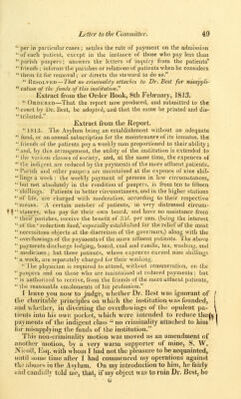
!['* per in particular cases ; settles the rate of payment on the admission of each patient, except in the instance of those who pay less than *' parish paupers; answers the letters of inquiry from the patients* friends ; informs the parishes or relations of patients when he considers them fit for removal; or directs the steward to do so. Resolved — That no criminality attaches to Dr. Best fur misappli- cation of the funds of this institution. Extract from the Order Book, 8th February, 1813. Ordered—That the report now produced, and submitted to the court by Dr. Best, be adopted, and that the same be printed and dis- tributed. Extract from the Report. 1813. The Asylum being an establishment without an adequate fund, or an annual subscription for the maintenance of its inmates, the friends of the patients pay a weekly sum proportioned to their ability; ^' and, by this arrangement, the utility of the institution is extended to the various classes of society, and, at the same time, the expences of the indigent are reduced by the payments of the more atfluent patients. *' Parish and other paupers are maintained at the expence of nine shil- lings a week : the weekly payment of persons in low circumstances, but not absolutely in the condition of paupers, is from ten to fifteen shillings. Patients in better circumstances, and in the higher stations of life, are charged with moderation, according to their respective *'means. A certain number of patients, in very distressed circum- f ? stances, who pay for their own board, and have no assistance from their parishes, receive the benefit of o5l. per ann. (being the interest of the ' reduction fund,' especially established for the relief of the most necessitous objects at the disCTetion of the governors,) along with the overflowings of the payments of the more atfluent patients. The above payments discharge lodging, board, coal and candle, tea, washing, and medicines ; but those patients, whose expences exceed nine shillings a week, are separately charged for their washing. The physician is required to attend, without remuneration, on the paupers and on those who are maintained at reduced payments; but is authorized to receive, from the friends of the more affluent patients, the reasonable emoluments of his profession. I leave you now to judge, whether Dr. Best was ignorant of / the charitable principles on which tlie institution was founded, and whether, in diverting- the overflowings of the opulent pa- tients into his own pocket, which were intended to reduce thefij' payments of the indigent class no criminality attached to him lor misapplying the funds of the institution. This non-criminality motion was moved as an amendment of another motion, by a very warm supporter of mine, S. W. Nicoi], Esq. with whom I had not the pleasure to be acquainted, until some time after I had commenced my operations against the abuses in the Asylum. On my introduction to him, he fairly and candidly told me, thatj if my object was to ruin Dr, Bestj he • -- G](https://iiif.wellcomecollection.org/image/b21058751_0059.jp2/full/800%2C/0/default.jpg)