Elementary bandaging and surgical dressing : with directions concerning the immediate treatment of cases of emergency for the use of dressers and nurses / by Walter Pye.
- Walter Pye
- Date:
- 1886
Licence: Public Domain Mark
Credit: Elementary bandaging and surgical dressing : with directions concerning the immediate treatment of cases of emergency for the use of dressers and nurses / by Walter Pye. Source: Wellcome Collection.
26/208 (page 14)
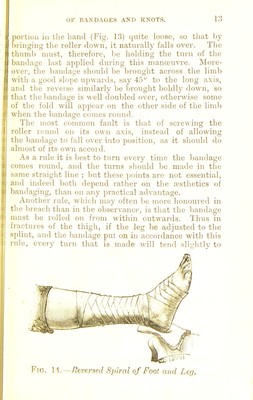
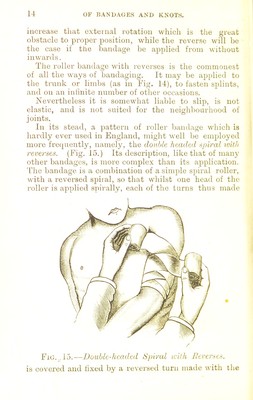
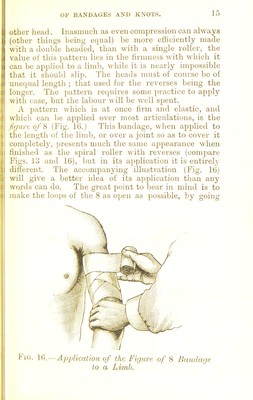
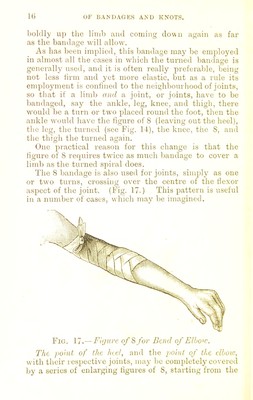
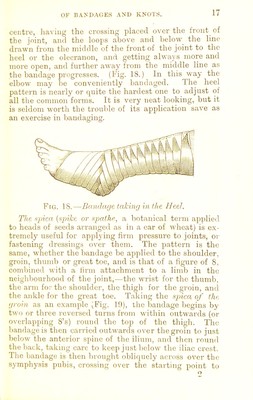
![increase tliat external rotation which is the great obstacle to proper position, while the reverse will be the case if the bandage be applied from witlioiit inwards. Tlie roller bandage with reverses is the commonest of all the ways of bandaging. It may be ap[ilied to the trunk or limbs (as in Fig. 14), to fasten splints, and on an inlinite number of other occasions. Nevertheless it is somewhat liable to slip, is not elastic, and is not suited for the neighlioiirhood of joints. In its stead, a pattern of roller bandage wliich is hardly ever used in England, miglit M'ell be employed more frequently, namely, the double, headed spiral with reverses. (Fig. 15.) Its description, like that of manj' other bandages, is more comjjlex than its application. The bandage is a combination of a simple s])iral roller, with a reversed si^iial, so that whilst one head of the roller is applied spirally, each of the turns thus made Fig.,, 15.—Double-headed Spiral icilh J\eversc.<. is covered and lixed by a reversed turn matle with tlie](https://iiif.wellcomecollection.org/image/b21778656_0026.jp2/full/800%2C/0/default.jpg)