The principles of medicine, founded on the structure and functions of the animal organism / By Samuel Jackson.
- Samuel Jackson
- Date:
- 1832
Licence: Public Domain Mark
Credit: The principles of medicine, founded on the structure and functions of the animal organism / By Samuel Jackson. Source: Wellcome Collection.
670/688 (page 648)
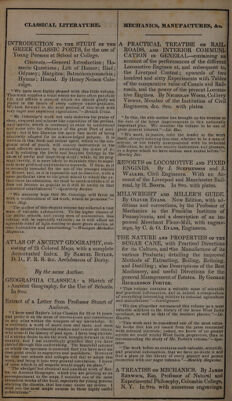
![{ ‘ : : % if at MECHANICS, MANUFACTURES, &o. f INTRODUCTION vo rae STUDY or truz/A PRACTICAL TREATISE on RAIL- GREEK CLASSIC POETS, for the use of | ROADS, ann INTERIOR COMMUNI] Young Persons at School or College. CATION in GENERAL—containing an} Contents.—General Introduction; Ho- account of the performances of the different. meric Questions; Life of Homer; Iliad ; Locomotive Engines at, and subsequent to, _ Odyssey; Margites; Batrachomyomachia ; the Liverpool Contest; upwards of two _ Hymns; Hesiod. By Henry Nelson Cole-| bundred and sixty Experiments with. Tables ridge. of the comparative value of Canals and Rail- roads, and the power of the present Locomo- tive Engines. By Nicnotas Woop, Colliery } Viewer, Member of the Institution of Civil Engineers, &c. Bvo. with plates. § ‘We have been highly pleased with this little volume. j This work supplies a want which we have often painfully 4 felt, and affords a manual which:we should gladly see fi placed in the hands of every embryo under-graduate. f We look forward to the next portion of this work with _§ Very eager and impatient expectation.”—British Critic. s clear, eloquent and scholar like exposition of the prelimi- nary matter, which is necessary in order. to understand ; and enter into the character of the great Poet of anti- fi. adinirably adapted fur its acknowledged purpose. It is written in that fresh and ardent spirit, which to the con- -§ genial mind of youth, will convey instruction in the p inost effective manner, by awakening the desire of it; § aud by enlisting the lively and buoyant feelings in the _ ff cause of useful and improving study; while, by its preg- _§ Hant brevity, it is more likely to stimulate than to super- sede more profound and extensive research. If then, as it j is avowedly intended for the use of the younger readers ff of Homer, and, as it is impossible net to discover, with a ‘more particular view to the great school to which the au- ; thor owes his education, we shall be much mistaken if it j does not become as popular as it will be usefal in that h celebrated establishment.’—-Quarierly Review. “We sincerely hope that Mr. Coleridge will favor us with a continuation of his work, which he promises.”— f Gent. Mag. q. “ The author of this elegant volume has collected a vast , mass of valuable information. To the higher classes of ~§ tite public schools, and young men of universities, this volume will be especially valuable; as it will afford an s agreeable relief of light reading to more grave studies, at once instructive and entertaining.”— Wesleyan Methodist Magazine. ATLAS OF ANCIENT GEOGRAPHY, con- _ sisting of 21 Colored Maps, with a complete Accentuated Index. By Samus. Burimr, D. D., F. R. 8. &e. Archdeacon of Derby. By the same Author. } GEOGRAPHIA CLASSICA: a Sketch of _ «Ancient Geography, for the Use of Schools. In 8vo- | Extract of a Letter from Professor Stuart of Andover, j “Ihave used Butler’s Atlas Classica for 12 or 14 years, } and prefer it on the score of convenience and correctness f tO any atlas within the compass of my knowledge. © It fis evidently a work of much care and taste, and most f happily adapted to classical readers and indeed all others, who consult the history of past ages.. I have long cherish- # ed a strong desire to see the work brought forward in this country, and I am eaceedingly gratified that you have q carried through this undertaking. ‘The beautiful manner itv which the specimen is executed that you have sent me j does great credit to engravers and publishers. It-cannot be that our schools and colleges will fail to adopt this 7 Work, and bring it into very general circulation. I know of vone which in all respects would supply its place.” _ “The abridged but classical and excellent work of But- ler, on Ancient Geography, which you are printing as an H accompaniment to the maps, I consider one of the most attractive works of the kind, especially for young persons qj Studying the classics, that has come under my notice. I wish you the most ample success in these highly useful publications.” © “In this, the able author has brought up his treatise to the date of the Jatest improvements in this nationally important plan. We consider the volume to be one of. great general interest.”—Lit. Guz. “We must, injustice, refer the reader to the work itself, strongly assuring him that, whether he be a man of science, or one totally unacquainted with its technical difficulties, he will here receive instruction and pleasure, in a degree which we have seldom seen united before.”— Monthly Rev. REPORTS on LOCOMOTIVE ann FIXED ENGINES. - By J. Sreppenson and J.J Wanker, Civil Engineers. With an Ac- count of the Liverpool and Manchester Rail-{ road, by H. Boorn. In 8vo. with plates. MILLWRIGHT anp MILLER’S GUIDE. | By Oniver Evans... New Edition, with ad-| ditions and corrections, by the Professor of § Mechanics: in. the Franklin Institute of Pennsylvania, and a description of an im- proved Merchant Flour-Mill, with engrav- ings, by C. & O. Evans, Engineers, THE NATURE ann PROPERTIES or tue} SUGAR CANE, with Practical Directions} for its Culture, and ‘the Manufacture of its various Products; detailing the improved ‘Methods of Extracting, Boiling, Refining, | and Distilling; also Descriptions of the Best} >? Machinery, and useful Directions for the general Management of Estates. By Grorer} Ricuarpson Porter. | * This. voluine contains a valuable mass of scientific f and practical information, and is, indeed, a compendium § of everything interesting relative to colonial agriculture and manufacture.”—Jntelligencer. “We can altogether recommend this volume as a most valuable additiou to. the library of the home West India merchant, as well as that of the resident plauter.”—Lit. | Gazette. “This work may be considered one of the most valua- ble books that has yet issued from the press connected with colonial interests; indeed, we know of no greater service we could render West India proprietors, than in recominending the study of Mr. Porter’s volume.”—Spec- } tator. : “The work before us contains such valuable, scientific, and practical information, that we have no doubt it will find a place in the library of every planter and person: connected with our sugar colonies.” —Monthly Magazine. — A TREATISE on MECHANICS. By James} Renwick, Esq. Professor of Natural and] Experimental Philosophy, Columbia College, | — N. Y.’ In 8vo. with numerous engravings. |](https://iiif.wellcomecollection.org/image/b33487066_0670.jp2/full/800%2C/0/default.jpg)