On some of the causes of the high rate of mortality in Greenock : with an account of their origin, as well as of the measures which have been taken, and are still required, for their abatement or removal / by James Greenock.
- Wallace, James
- Date:
- 1860
Licence: Public Domain Mark
Credit: On some of the causes of the high rate of mortality in Greenock : with an account of their origin, as well as of the measures which have been taken, and are still required, for their abatement or removal / by James Greenock. Source: Wellcome Collection.
Provider: This material has been provided by The Royal College of Surgeons of England. The original may be consulted at The Royal College of Surgeons of England.
3/30
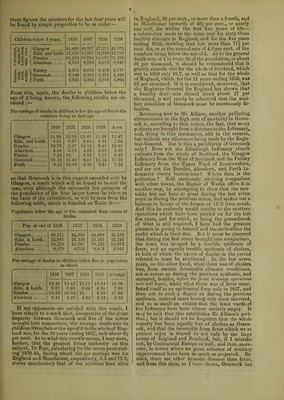
![REPLY TO STRICTURES OX THE FOLLOWING PAPER. \From the GreenocJc Telegraph of November S, I860.] In preparing the paper which has lately ap- peared in these columns, I never for a moment dreamt that I would escape the charge of exag- geration or of false colouring. Nor have I been disappointed, for several have eagerly rushed into print to rescue the town from what is styled ‘‘un- merited obloquy.” So far, however, as argument is concerned nothing has been produced- to satisfy any person who would calmly and dispassionately examine the facts for himself, that the statements which I have made are, in any essential particular, wrong or inconclusive. They rather go to corrobor- ate everything I have advanced, so much so that I would be quite content to wait till the returns of next year’s census are made public, and to leave all cavillers to the pleasing delusion that I had met with a complete refutation, but for the fear that that section which exists in every community, and which a great statesman not long ago denominated “ the dirty party,” might construe my silence into a reason for adopting a laissez-faire or do-nothing policy. For the especial behoof, then, of this party, I venture to offer a remark or two, and chiefly on the charge which has been brought against the Regis rar- General for having estimated the population of Greenock too low. I do this, not because I believe that that officer requires any champion, but because the calculations ou which my paper is based are founded on the reports which he lias published from time to time. At the outset, then, I have to state that there are two modes of esti mating a population—one consisting in taking note of the excess of births over deaths or the contrary, and the other in taking the average of the increase during the decade preceding the last census and adding this year by year till another census comes round. The former pre-supposes that no other change takes place in the population; the latter, on the other hand, recognises not ouly the ordinary increase by excess of births over deaths, but emigration and immigration as well- It is plain, therefore, that in the vast majority of instances the one last mentioned is the preferable mode.* It is, accordingly, the one adopted by statisticians in inquiries of this kind, and is the one employed by the Registrar General for making a comparative estimate of the death-rate of one town with auother. By it, as the first of my tables showed, Greenock is fo\jnd, to use the words of Mr Allison, to be “ one of the uuhealthiest towns of Scotland.” The Master of Works, however, calls the fact so demonstrated “ an erroneous impression,” on the ground that the excess of births over deaths would make the popula- tion over 40,000, aud not under 38,000 merely, a result which, he further believes, must be supported by the fact of the great increase in workmen’s houses, as well as by a hypothetical calculation of * The best mode, of course, if at all attainable, would be one essentially the same as this, but in which, at the same time, allowance would be made for what mathematicians would call the numbers living in each house. The increase in workmen’s houses is, no doubt, a fact, and the cal culation may turn out to be something more than hypothetical, but did it never occur to Mr Allison that the same may be true of the other large towns, particularly Glasgow and Dundee, with both of which Greenock occupies in the matter of health a position which may well be called unenviable ? As to the estimate of the population from the excess of births over deaths, it is quite possible, indeed not at all unlikely, that there are exceptional instances of towns increasing more in this way than others, and that Greenock may be one of these. In fact, the Registrar-General in his report for 1858 admitted this, and made calculations accordingly, as will be seen from the following extract :— “ The population lias been estimated on the usual prin- ciple of supposing that the present increase is similar to that which occurred between 1841 and 1851. In the accompanying tables, however, is given, along with the estimate for 1858, the population as deduced from the excess of births over deaths since the Registration Act came into operation—giving, by the census increase, the numbers to the middle of 1855, and from that date to the middle of 1858, the actual increase of births over deaths. This mode of calculation under-estimates the actual increase in Glasgow and the larger towns, as it takes no notice of the immigrants, so that for such towns the usual mode of calculation gives the nearest approximation. From circumstances, however, which do not require to be here specified, the increase of births over deaths probably gives the nearest approximation to the population in the case of Paisley, Greenock, Leith, and Perth ” Iii like manner he reported for 1859, the death rate, calculating from the birth estimate of the popula- tion, which he thus tabulated, being found in 1858 to be for the eight towns, taken in their usual order, respectively, 1 in 32, 41, 38, 48, 39,' 36, 45, and 38, and in 1859, 1 in 34, 47, 40, 46, 42, 28, 51, and 45, so that really the relative position of Greenock is in this matter essentially the same as that brought out in my first table.* Whatever differences, how- ever, may exist will be considerably lessened if ac- cordance is given to the opinion of the Registrar- General that this mode of calculation under-esti- mates ihe population of Glasgow, Edinburgh, Dun- dee, and Aberdeen, To show that this opinion is a reasonable one, I have simply to call attention to the fact, that Dr Strang, who is surely as much entitled to rank as an authority as Mr Allison, makes the population of Glasgow, in his last report to the magistrates of that city, no less than 407,000f, so that in a comparative estimate, the result as between Greenock and Glasgow would, from these figures, be * I stated this in reply to Mr Allison’s remarks at the second day's meeting of the Sanitary Section of the Association. For some reason, however, which is perhaps hist known to tho Editor of the Greenock Advertiser, my reply did not appear In the report which he gave of the proceedings. + Taking in the poitions of the Barony and Govan parishes beyond the Parliamentary boundary, he estimates the populu](https://iiif.wellcomecollection.org/image/b22327071_0005.jp2/full/800%2C/0/default.jpg)