Memoirs ... Figures and descriptions illustrative of British organic remains. Decade II [VII and XI. Trilobites, with descriptions by J.W. Salter].
- Geological Survey of Northern Ireland
- Date:
- 1849-1864
Licence: Public Domain Mark
Credit: Memoirs ... Figures and descriptions illustrative of British organic remains. Decade II [VII and XI. Trilobites, with descriptions by J.W. Salter]. Source: Wellcome Collection.
21/270 page 7
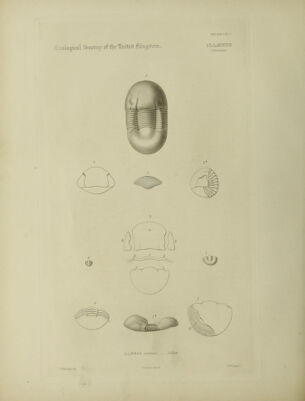
![Other British Species of Phacops, of the Section Dalmannia. 1. P. sp. [fig. 16 in PI. I.] P. lavis, capite quam in P. caudato, nisi lobis glabellas tumidioribus;—caudd triangulari, fere aquilatera, convexa, apice acutu baud mucronato, axi 13-16 annulato, costis lateralibus 10-12, simplicibus, vix curvatis, ad marginem cequalem angustum abrupte terminatis. Length of tail l£ inches. There are but imperfect heads in the collections of the Geo- logical Society and Geological Survey. The characters of the tail distinguish it from P. caudatus; it has much more numerous ribs, which are but little curved, and not dupli- cate; the margin, too, is equal all round, not expanded or mucronate at the end. Young specimens have not the full number of ribs, and a few of the upper ones are slightly divided. The most prominent analogy is with P. Hausmanni, Brongn.; but that is strongly tuberculate, almost spinous, all over. P. pleuroptyx (Green), is also like, but has the lateral ribs duplicate. The species of this group so closely resemble each other, that we dare not give a name. Should it prove new, it might be called P. Weaveri. Localities.—Caradoc sandstone of Long’s Quarry, Damory Bridge, and Charfield Green, Tortworth, Gloucestershire ; (all small); Woodford Green, ditto; (large). 2. P. obtusicaudatus. P. capite quam in P. caudato, sed latiore;—caudd brevi, lato, subtriangulari, apice angulato, obtuso; axi lato, convexo, 11-12 annulato, obtuso; costis lateralibus 9, duplicatis, rectis, ad marginem angustum cequalem abrupte terminatis. We merely note this curious species here; it will be figured and described in Prof. Sedgwick’s work on Westmoreland. Locality.—Coldwell, in flags above the Coniston limestone, Westmoreland. 3. P. truncato-caudatus, Portlock, Geol. Rep. Tyrone, &c., pi. 2, f. 1-4, and Para- doxides1! Bucephali var., pi. 1, f. 8 (hypostome). P. granulatus, capite antice truncato, oculis maximis subdepressis; pleuris obtusis, fulcra ab axi valde remoto; caudce axi annulato, angusto, costis lateralibus 14-16, apict emarginato. This interesting species, while in the large eyes and strong head spines, numerous joints of the tail, and general depressed form, it is nearly allied to the other Dalmannia,—yet indicates more than any other the close affinity of this section with Phacops, for the facial suture is only just within the margin, the tail rather rounded than produced, the pleura: have their furrows strong and curved forwards at their obtuse ends, and they are bent down at the distant fulcrum, so as to be much better fitted for rolling up than is usual in Dalmannia. For the first half of the thorax they are scarcely at all bent back from the fulcrum; the posterior pleurae are more in the usual way. The hypostome is very much extended at its base, is pointed, and has two pair of oblique furrows. Localities.—Lower Silurian. Tyrone, Ireland. Coniston, Westmoreland. Horderly, Shropshire. Var. /3 affinis. Cauda axi latiore—Dalmannia affinis, Salter, in Memoirs of the Geol. Survey, vol. ii., part 1, pi. 5, f. 5. It is to be feared there are not sufficient grounds for separating this species, founded only on caudal shields. A tolerably perfect tail in Mr. D. Sharpe’s collection, and an imperfect one in the Survey Collection, have the axis considerably wider than in Portlock’s originals. Specimens, however, in Sir R. I. Murchison's cabinet, show intermediate characters. Localities.—Lower Silurian. Llandowror, Caermarthenshire. Coniston, Westmore- land. Phacops is a widely distributed genus or group of trilobites, remarkable for the large facets of the eyes,—the distinct trilobation of head, thorax, and tail, the furrows separating](https://iiif.wellcomecollection.org/image/b22013027_0021.jp2/full/800%2C/0/default.jpg)


 No text description is available for this image
 No text description is available for this image
 No text description is available for this image