A handbook of the diseases of the eye and their treatment / by Sir Henry R. Swanzy and Louis Werner.
- Swanzy, Henry R. (Henry Rosborough), 1843-1913
- Date:
- 1907
Licence: In copyright
Credit: A handbook of the diseases of the eye and their treatment / by Sir Henry R. Swanzy and Louis Werner. Source: Wellcome Collection.
Provider: This material has been provided by The University of Leeds Library. The original may be consulted at The University of Leeds Library.
107/790 page 83
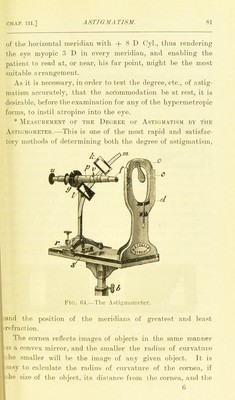
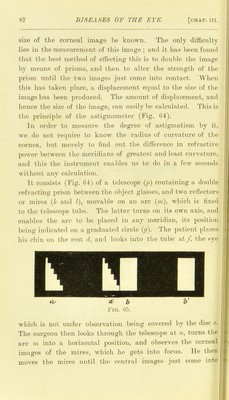
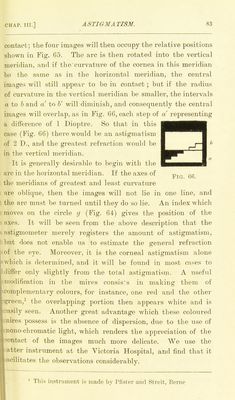
![contact; the four images will then occupy the relative positions shown in Fig. 65. The arc is then rotated into the vertical meridian, and if the'curvature of the cornea in this meridian be the same as in the horizontal meridian, the central images will still appear to be in contact ; but if the radius of curvature in the vertical meridian be smaller, the intervals a to h and a to h' will diminish, and consequently the central images will overlap, as in Fig. 66, each step of a representing a difference of 1 Dioptre. So that in this case (Fig. 66) there would be an astigmatism of 2 D., and the greatest refraction would be in the vertical meridian. It is generally desirable to begin with the arc in the horizontal meridian. If the axes of the meridians of greatest and least cui'vature are oblique, then the images will not lie in one line, and ( the arc must be turned until they do so lie. An index which moves on the circle c/ (Fig. 64) gives the position of the axes. It will be seen from the above description that the 1 astigmometer merely registers the amount of astigmatism, ! but does not enable us to estimate the general refraction 1 of the eye. Moreover, it is the corneal astigmatism alone >which is determined, and it will be found in most ca.ses to 1 differ only slightly from the total astigmatism. A useful modification in the mires consis's in making them of -complementary colours, for instance, one red and the other ■!green,^ the overlapping portion then appears white and is >3asi]y seen. Another great advantage which these coloured imires possess is the absence of dispersion, due to the use of imono-chromatic light, which renders the appreciation of the Montact of the images much more delicate. We use the 1 atter instrument at the Victoria Hospital, and find that it ■facilitates the observations considerably. ' This instrument is made by Tfister and Streit, Rcinc](https://iiif.wellcomecollection.org/image/b21512577_0107.jp2/full/800%2C/0/default.jpg)
 No text description is available for this image
 No text description is available for this image
 No text description is available for this image