Sixty-eight cases of pernicious anaemia / by Herbert French.
- French, Herbert Stanley, 1875-1951.
- Date:
- [1909]
Licence: In copyright
Credit: Sixty-eight cases of pernicious anaemia / by Herbert French. Source: Wellcome Collection.
Provider: This material has been provided by The Royal College of Surgeons of England. The original may be consulted at The Royal College of Surgeons of England.
102/126 page 200
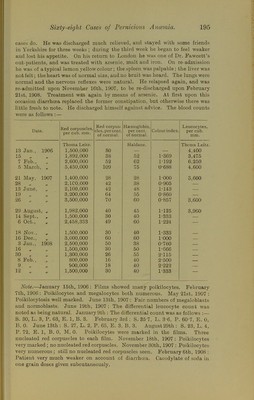
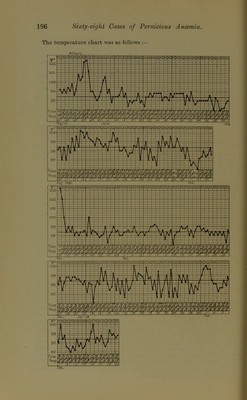
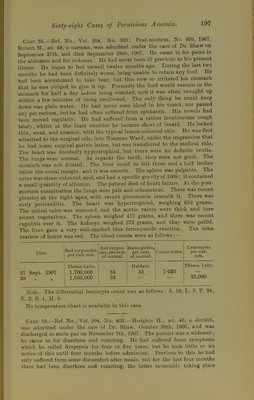
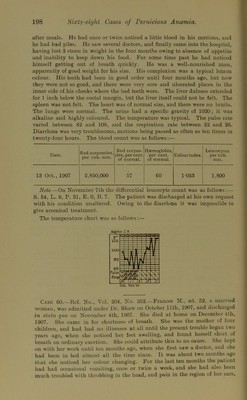
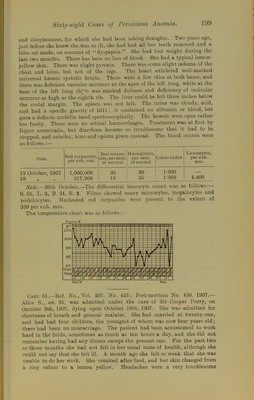
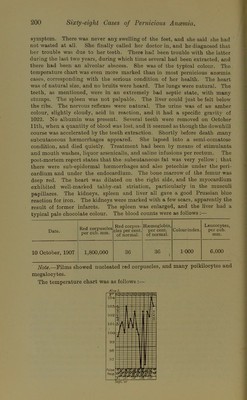
![S}-mptom. There was never any swelling of the feet, and she said she had not wasted at all. She finally called her doctor in, and he diagnosed that her trouble was due to her teeth. There had been trouble with the latter during the last two years, during which time several had been extracted, and there had been an alveolar abscess. She was of the typical colour. The temperature chart was even mote marked than in most pernicious ansemia cases, corresponding with the serious condition of her health. The heart was of natural size, and no bruits were heard. The lungs were natural. The teeth, as mentioned, were in an extremely bad septic state, with many stumps. The spleen was not palpable. The liver could just be felt below the ribs. The nervous reflexes were natural. The urine was of an amber colour, slightly cloudy, acid in reaction, and it had a specific gravity of 1022. No albumin was present. Several teeth were removed on October 11th, when a quantity of blood was lost, and it seemed as though the downhill course was accelerated by the teeth extraction. Shortly before death many subcutaneous haemorrhages appeared. She lapsed into a semi-comatose condition, and died quietly. Treatment had been by means of stimulants and mouth washes, liquor arsenicalis, and saline infusions per rectum. The post-mortem report states that the subcutaneous fat was very yellow ; that there were sub-epidermal haemorrhages and also petechiae under the peri- cardium and under the endocardium. The bone marrow of the femur was deep red. The heart was dilated on the right side, and the myocardium exhibited well-marked tabby-cat striation, particularly in the musculi papillares. The kidneys, spleen and liver all gave a good Prussian blue reaction for iron. The kidneys were marked with a few scars, apparently the result of former infarcts. The spleen was enlarged, and the liver had a typical pale chocolate colour. The blood counts were as follows :— Date. Red corpuscles per cub. ram. Red corpus- cles per cent, of normal. Haemoglobin, per cent, of normal. Colour index. Leucocytes, per cub. mm. 10 October, 1907 1,800,000 36 36 , 1 000 6,000 ]^ote.—Films showed nucleated red corpuscles, and many poikilocytes and megalocytes. The temperature chart was as follows :— AhcsS.](https://iiif.wellcomecollection.org/image/b22425044_0104.jp2/full/800%2C/0/default.jpg)