Sixty-eight cases of pernicious anaemia / by Herbert French.
- French, Herbert Stanley, 1875-1951.
- Date:
- [1909]
Licence: In copyright
Credit: Sixty-eight cases of pernicious anaemia / by Herbert French. Source: Wellcome Collection.
Provider: This material has been provided by The Royal College of Surgeons of England. The original may be consulted at The Royal College of Surgeons of England.
23/126 page 121
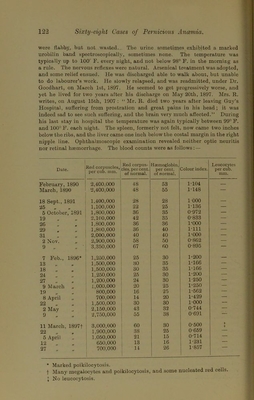
![ABSTRACTS OF THE NOTES OF THE SIXTY-EIGHT CASES. [N.B.—When no mention is made of any particular point, it signifies that there was no mention of it in the original report. If, for instance, “ urobilin is not mentioned, it cannot be assumed to have been absent; if it had been looked for and not found it would be mentioned as “no urobilin found, and so on.] (The References are to the Medical Ward Reports.) Case 1.—Ref. Nos., Vol. 109, No. 89; Vol. 114, No. 64; Vol. 123, No. 104 ; Vol. 147, No. 96 ; Vol. 153, No. 113.—Charles R., set. 45 ; a brick- layer. First admitted under Dr. Pavy, in 1889, for mental irritability, weakness in the legs, and pain in the lumbar region. His colour at that time was not apparently abnormal, and the diagnosis made was lumbago and paresis of the legs. The pains in the back were very acute, and the patient had had three or four attacks a year for the previous fifteen years. There was no hsematuria nor other indication that the pains might have been due to renal colic, and lumbago seemed to fit the case. In view, however, of its subsequent course it seems at least possible that the pains were similar to those which other pernicious ansemia cases often complain of in one part of the body or another. Less than a year later, in January, 1890, the patient was re-admitted, under Dr. Pavy, for loss of physical strength, failure of appetite, diarrhoea, and night sweating, and the skin was now pale and waxy, and had been obviously so for more than two months. The lungs and heart were natural. There were no retinal haemorrhages, but occasional specks of blood were expectorated. There was no other bleeding. The urine was high coloured ; it contained no albumin, blood, nor sugar. The blood count indicated pernicious ansemia. The patient was treated with pilula colocynthi et hyoscyami, and mistura ferri et ammonii citratis, and improved in general condition, though the blood count remained much the same. By September, 1891, the patient was so weak that he could not work, though he had worked between his discharge and then. He was re- admitted, under Dr. Washhourn, and was in hospital from September 4th, 1891, to November 30th, 1891. The attacks of pain in the loins were still continued, and they were very bad. There were neither enlarged glands nor spleen, no vomiting, and no diarrhoea. Treatment was now by means of liquor arsenicalis, which was increased up to niix. three times a day, with material relief to the ansemia. He went out in November, 1891, and remained well enough to work, on and off, for over four years, before repetition of his old weakness and pallor compelled him to seek hospital treatment again. He was under Dr. Hale White, in Clinical Ward, from February 7th, 1896, to March 9th, 1896. He presented the typical pale yellow colour. His tissues](https://iiif.wellcomecollection.org/image/b22425044_0025.jp2/full/800%2C/0/default.jpg)