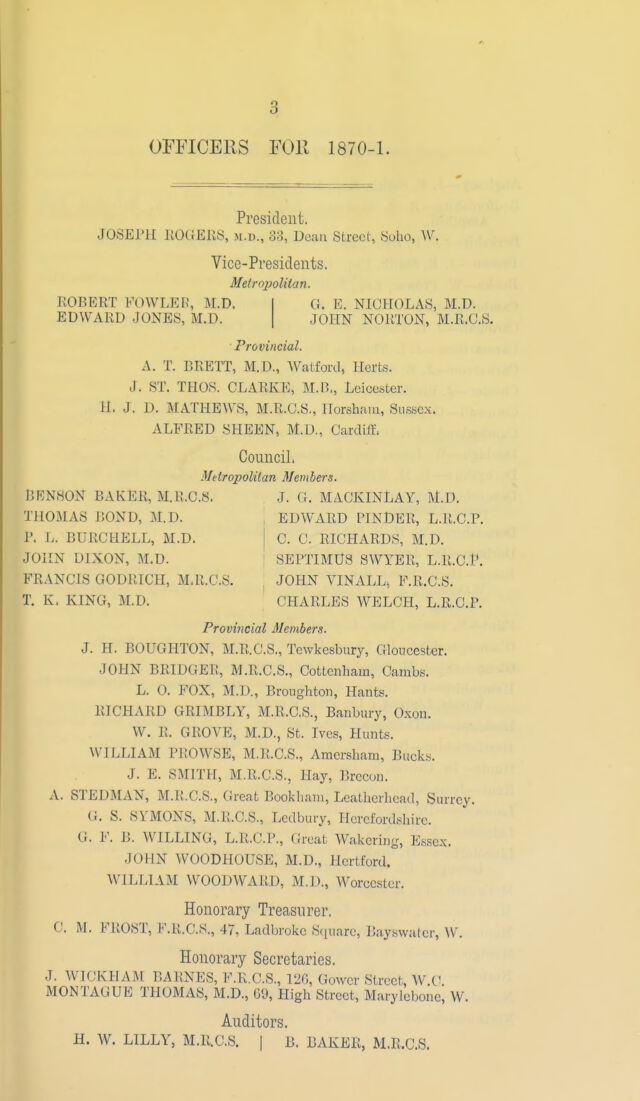
Laws, list of officers for the year 1870-71, and of the honorary members and members : to which is added a report of the annual meeting ... July 13th, 1870 / Poor-Law Medical Officers' Association.
- Date:
- [1870]
Licence: Public Domain Mark
Credit: Laws, list of officers for the year 1870-71, and of the honorary members and members : to which is added a report of the annual meeting ... July 13th, 1870 / Poor-Law Medical Officers' Association. Source: Wellcome Collection.
Provider: This material has been provided by the Royal College of Physicians of Edinburgh. The original may be consulted at the Royal College of Physicians of Edinburgh.
37/48 page 37
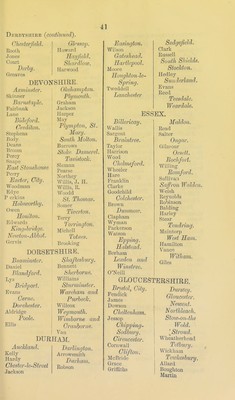
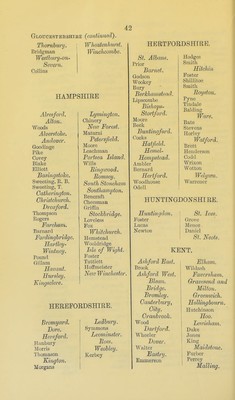
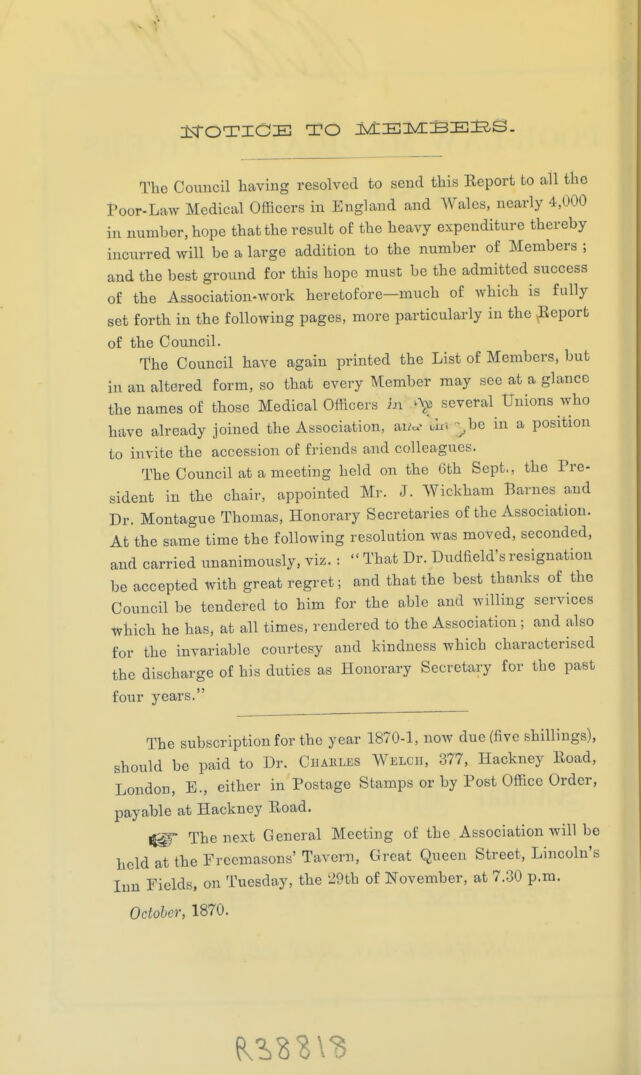
![SGcoutl year had reached 80 ; and then coalescing with Richard Griftin s Association, started two years ago with 300. At the last meeting there were 800 rnernbens and since then 120 gentlemen had joined, forming an association spread over the country, from Northumberland to the Land's End. 8ince its formation, the Association had strenuously advocated certain objects, the first of which, life appointments for all Poor Law Medical Olticers, had been conceedetl by Mi: Goschen, who had signified his intention of issuing a general order to effect this. The second was to obtain entire, instead of partial payment of salaries from the consolidated fund. This was advocated because the incidence of local taxation was such that large portions of the community escaped altogether from pay- ment, whilst those who were obliged to contribute, did so on unequal terms. Then, again, pauperism was now so migratory, that it was year by year ceasing to be wholly parochial, and evincing an increasing dis- jiosition to aggregate in large I owns to the relief of the country dii-tricts. Moreover, the diseases of the poor could not be wholly localised, for an epidemic starting from a district where sanitary rcfpiirements were dis- regarded, might spread like a wave over a large extent of country to where those requirements were regarded. It was advocated also, because the Central Administration would be more likely to put the stipends on a satisfactory footing than a local authority would; and then the results so disastrous to the interests of the community which had arisen from the false and niggardly economy in which local authorities had made their arrange- arrangements for mctlical relief would be determined. [Hear.] The As.sociation al.<o desired that all drugs and medical appliances should be provided, otherwise than by the medical officers, and it urged the cstabli.shnicnt of dispensaries in suitable localities, on the principle adopted in Ireland during the last eighteen years, with the happiest results to the health and wealth of the community. [Hear.] The fourth, object of the A.ssociation--the superannuation allowance for medical officers had been conceded by the House of Commons. [Cheers.] The fifth object of the Association was to have the area ami population limited to the extent defined in the consolidated orders of the Toor-l.aw Board, namely, tliat the population shall not exceed L5,000, nor the area of a district 15,000 statute acres. Had these orders ever been enforced the reduction of the staff at llirmingham, whereby each medical officer had a district of 4-5,000 persons a.^signed him would not have been permitted, and from investigations which he had made, he found (hat there were 583 districts which exceeded 15,000 statute acres, and 7o districts in Wales extending seven miles from the Medical Officer's re.~ dence; 120 districts exceeding i5,000 persons in each ; G27 districts hold by 291 Medical Officers, and 200 Medical Officers who attended from 1,000 to 10,000 patients aniuially ; giving altogether 1,378 appointnients contrary to the rules and regulations of the Poor Law Board. He contended that these figures absolutely disposed of the para- graph in the report of the 8elect Committee of 1801, stating that there are no sufficient grounds for materially interfering with the present .system of medical relief, which appears to your Committee to be aclminis- tered with general advantage. Ho had instituted incjuiries as to the ability of the poor to pay for medical relief, and he had arrived at the conclusion that there was much ignorance on this point, for the average earnings of the labouring classes were insuflicent to enable them to pay for medical necessaries, and the provision in benefit clubs for medical attendance was almost entirely limite 1 to the head of the family. To show the imporLancc of a modified and more efficient .system of medical relief, he quoted from the last report of the Poor Law Board to the effect that ot 1,085,000 paupers, T [)er cent, only were adult males destitute on account of want of work, while 30 per cent, of the in-door and 13 per](https://iiif.wellcomecollection.org/image/b21920606_0039.jp2/full/800%2C/0/default.jpg)