Appendicitis : its pathology and surgery / by Charles Barrett Lockwood.
- Lockwood, Charles Barrett, -1914.
- Date:
- 1906
Licence: In copyright
Credit: Appendicitis : its pathology and surgery / by Charles Barrett Lockwood. Source: Wellcome Collection.
Provider: This material has been provided by The University of Leeds Library. The original may be consulted at The University of Leeds Library.
85/308 page 69
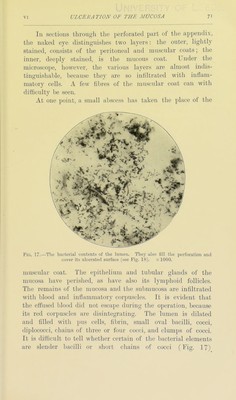
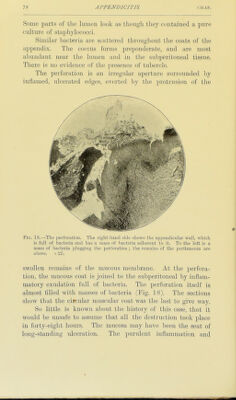
![course of an operation upon a boy, set. twelve, I met with an acute suppurative peritonitis around an acutely inflamed, but not perforated appendix. The latter was adherent to the caecum. Before the operation, the temperature was 99°F. and the pulse ] 130. The abdomen was distended and rigid, and tender all over : it was especially rigid and tender at the right iliac fossa. The result of the rectal examination was negative. The appendix was excised and the abdomen drained. The patient made a good recovery. The appendix possesses a peritoneal coat covered with a thick layer of fibrinous exudation ; muscular coats which are □edematous and infiltrated with inflammatory cells; and a submueosa in the same condition. The mucosa has dis- appeared. All the blood-vessels and lymphatics are dilated, and many of the former full of blood. 'W'hat I take to be the lumen of the appendix is empty. The fibrinous exudation contains small oval bacilli singly, in pairs, and small clumps. Similar bacilli are scattered about t he submucous coats, and probably about the muscular coats too. The bacterial invasion of the appendicular walls may end in perforating ulcer. It may also end in partial or complete necrosis. The following is an instance of perforating ulcer. Case 14.—Appendicitis with Ulceration of the Mucosa —Perforation, and Acute Suppurative Peritonitis—Subsequent Ventral Hernia.—B. C.,a Polish Jewess, aged sixteen years, was admitted into St. Bartholomew's Hospital under my colleague, Dr. Norman Moore, who requested me to see her with a view to operation. Owing to her apathy and ignorance of English, a history was difficult to obtain. It seemed that two days previously (March 2, 1890) she had been seized, about 4 p.m., whilst tailoring, with a violent pain in the abdomen, followed by vomiting, and an action of the bowels. I saw her less than forty-eight hours after this attack. She was very pallid and listless, with a temperature 99 ¥. and pulse 104. No further vomiting had occurred, but the bowels had not acted again, and the passage of flatus was doubtful. The house physician, Mr. Palgrave, said the pulse was becoming more rapid. The abdomen was distended, but moved](https://iiif.wellcomecollection.org/image/b21519249_0085.jp2/full/800%2C/0/default.jpg)

 No text description is available for this image
 No text description is available for this image
 No text description is available for this image