Observations on certain parts of the animal oeconomy. Inclusive of several papers from the Philosophical transactions, etc / by John Hunter ... With notes by Richard Owen.
- John Hunter
- Date:
- 1840
Licence: Public Domain Mark
Credit: Observations on certain parts of the animal oeconomy. Inclusive of several papers from the Philosophical transactions, etc / by John Hunter ... With notes by Richard Owen. Source: Wellcome Collection.
414/494 page 406
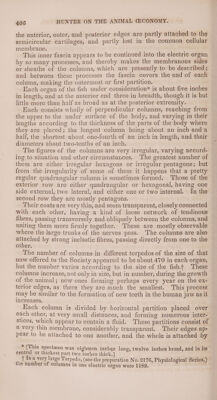
![the anterior, outer, and posterior edges are partly attached to the semicircular cartilages, and partly lost in the common cellular membrane. This inner fascia appears to be continued into the electric organ by so many processes, and thereby makes the membranous sides or sheaths of the columns, which are presently to be described ; and between these processes the fascia covers the end of each column, making the outermost or first partition. Each organ of the fish under consideration* is about five inches in length, and at the anterior end three in breadth, though it is but little more than half as broad as at the posterior extremity. Each consists wholly of perpendicular columns, reaching from the upper to the under surface of the body, and varying in their lengths according to the thickness of the parts of the body where they are placed; the longest column being about an inch and a half, the shortest about one-fourth of an inch in length, and their diameters about two-tenths of an inch. The figures of the columns are very irregular, varying accord- ing to situation and other circumstances. The greatest number of them are either irregular hexagons or irregular pentagons; but from the irregularity of some of them it happens that a pretty regular quadrangular column is sometimes formed. Those of the exterior row are either quadrangular or hexagonal, having one side external, two lateral, and either one or two internal. In the second row they are mostly pentagons. Their coats are very thin, and seem transparent, closely connected with each other, having a kind of loose network of tendinous fibres, passing transversely and obliquely between the columns, and uniting them more firmly together. These are mostly observable where the large trunks of the nerves pass. The columns are also iaonae by strong inelastic fibres, passing directly from one to the other. The number of columns in different torpedos of the size of that now offered to the Society appeared to be about 470 in each organ, but the number varies according to the size of the fish.t These columns increase, not only in size, but in number, during the growth of the animal; new ones forming perhaps every year on the ex- terior edges, as there they are much the smallest. This process may be similar to the formation of new teeth in the human jaw as it increases. Each column is divided by horizontal partition placed over each other, at very small distances, and forming numerous inter- stices, which appear to contain a fluid. These partitions consist of a very thin membrane, considerably transparent. Their edges ap- pear to be attached to one another, and the whole is attached by * ° ° . ° 4 j { ‘(This specimen was eighteen inches long, twelve inches broad, and in its central or thickest part two inches thick.] t Ina very large Torpedo, (see the preparation No. 2176, Physiological Series,) the number of columns in one electric organ were 1182. ~ ,](https://iiif.wellcomecollection.org/image/b33292292_0414.jp2/full/800%2C/0/default.jpg)