Observations on certain parts of the animal oeconomy. Inclusive of several papers from the Philosophical transactions, etc / by John Hunter ... With notes by Richard Owen.
- John Hunter
- Date:
- 1840
Licence: Public Domain Mark
Credit: Observations on certain parts of the animal oeconomy. Inclusive of several papers from the Philosophical transactions, etc / by John Hunter ... With notes by Richard Owen. Source: Wellcome Collection.
93/494 page 85
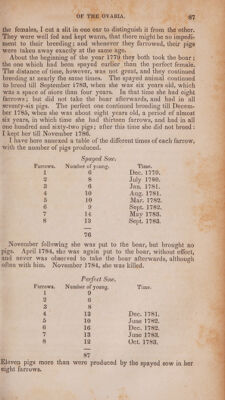
![he tela: SL UA es “se Rt TRE tis WEP Ns Ear SIN IRE oy a RR get Ua es ‘ Vie .: i aa, 4% Wy wy ; ‘eS : 7 : MER Var, aes : ° ‘ i Pe Ta 9 OF DHE OVARIA. ee clude, that this change is merely the effect of age, and obtains toa certain degree in every class of animals. We find something similar taking place even in the human species; for that increase of hair observable on the faces of many women in advanced life is an ap- proach towards the beard, which is ne of the most distinguishing secondary properties of man. ici | | distinguish them from each other, acquiring about the time of puberty secondary properties, which clearly characterize the male and female, the male at this time receding from the female, and as- suming the secondary properties of his sex. rae, The female, at a much later time of life, when the powers of pro- said, except from mere structure of parts, to be of no sex, even re- ceding from the original character of the animal, and approaching, in appearance, towards the male, or perhaps more properly towards the hermaphrodite. 7 Rs — = 5. AN EXPERIMENT TO DETERMINE THE EFFECT OF EXTIRPATING ONE OVARIUM UPON THE NUMBER OF YOUNG PRODUCED.* In all animals of distinct sex, the females, those of the Bird-kind excepted, have, I believe, two ovaria, and of course the oviducts are in pairs. | By distinct sex I mean when the parts destined to the purposes of generation are of two kinds, each kind appropriated to an in- dividual of each species, distinguished by the appellation of male and female, and equally necessary to the propagation of the animal. The testicles, with their appendages, constitute the male; the ovaria, and their appendages, the female sex. As the ovaria are the organs which, on the part of the female, furnish what, is necessary towards the production of. the third, or young animal, and as females appear to have a limited portion of the middle stage of life allotted for that purpose, it becomes a question, whether those organs are worn out by repeated acts of propaga- tion; or whether there is not a natural and constitutional period to that power on their part, even if such power has never been exerted ? If we consider this subject in every view, taking the human species as an example, we shall discover that circumstances, either local or constitutional, may be capable of extinguishing in the female the faculty of propagation. Thus we may observe when a woman begins to breed at an early period, as at fifteen, and has her children * (Originally published in the Philosophical Transactions, vol, Ixxvii., p. 233 ; read, March 22, 1787.] ?; } ? 9 td 1 lees Fogg eh Wc > y ; QS ee i LCs | Na By ae pee ad ihe](https://iiif.wellcomecollection.org/image/b33292292_0093.jp2/full/800%2C/0/default.jpg)