A treatise on the diseases of the eye / By J. Soelberg Wells... Together with selections from the test-types of Prof. E. Jaeger and Prof. H. Snellen.
- Wells, J. Soelberg (John Soelberg), -1879
- Date:
- 1883
Licence: Public Domain Mark
Credit: A treatise on the diseases of the eye / By J. Soelberg Wells... Together with selections from the test-types of Prof. E. Jaeger and Prof. H. Snellen. Source: Wellcome Collection.
Provider: This material has been provided by the Harvey Cushing/John Hay Whitney Medical Library at Yale University, through the Medical Heritage Library. The original may be consulted at the Harvey Cushing/John Hay Whitney Medical Library at Yale University.
116/898 page 122
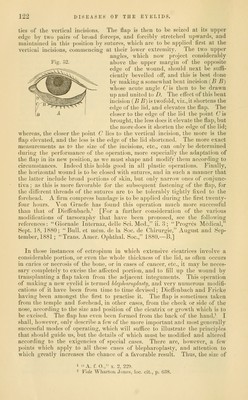
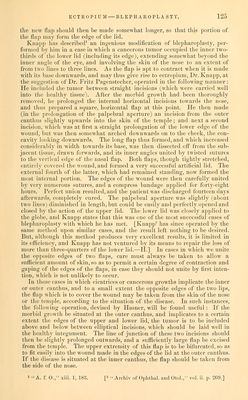
![ties of the vertical incisions. The flap is then to be seized at its upper edge by two pairs of broad forceps, and forcibly stretched upwards, and maintained in this position by sutures, which are to be applied first at the vertical incisions, commencing at their lower extremity. The two upper angles, which now project considerably Fig. 52. above the upper margin of the opposite edge of the wound, should next be suffi- ciently bevelled off, and this is best done by making a somewhat bent incision (B B) whose acute angle C is then to be drawn up and united to D. The effect of this bent incision (i> B) is twofold, viz., it shortens the edge of the lid, and elevates the flap. The \b ^ I closer to the edge of the lid the point C is brought, the less does it elevate the flap, but the more does it shorten the edge of the lid; whereas, the closer the point G lies to the vertical incision, the more is the flap elevated, and the less is the edge of the lid shortened. The more exact measurements as to the size of the incisions, etc., can only be determined during the performance of the operation, more especially the adaptation of the flap in its new position, as we must shape and modify them according to circumstances. Indeed this holds good in all plastic operations. Finally, the horizontal wound is to be closed with sutures, and in such a manner that the latter include broad portions of skin, but onlj'^ narrow ones of conjunc- tiva ; as this is more favorable for the subsequent fastening of the flap, for the different threads of the sutures are to be tolerably tightly fixed to the forehead. A firm compress bandage is to be applied during the first twenty- four hours. Von Graefe has found this operation much more successful than that of Dieffenbach.' [For a further consideration of the various modifications of tarsoraphy that have been proposed, see the following references: Giornale Internaz, delle Sci. Med., ii. 3 ; Progres Medical, Sept. 18, 1880; Bull, et mem. de la Soc. de Chirurgie, August and Sep- tember, 1881; Trans. Amer. Ophthal. Soc, 1880.—B.] In those instances of ectropium in which extensive cicatrices involve a considerable portion, or even the whole thickness of the lid, as often occurs in caries or necrosis of the bone, or in cases of cancer, etc., it may be neces- sary completely to excise the affected portion, and to fill up the wound by transplanting a flap taken from the adjacent integuments. This opei'ation of making a new eyelid is termed blepharoplasty, and very numerous modifi- cations of it have been from time to time devised; Dieflenbach and Fricke having been amongst the first to practise it. The flap is sometimes taken from the temple and forehead, in other cases, from the cheek or side of the nose, according to the size and position of the cicatrix or growth which is to be excised. The flap has even been formed from the back of the hand.^ I shall, however, only describe a few of the more important and most generally successful modes of operating, which will suflice to illustrate the principles that should guide us, but the details of which must be modified and altered according to the exigencies of special cases. There are, however,, a few points which apply to all these cases of blepharoplasty, and attention to which greatly increases the chance of a favorable result. Thus, the size of 1 A. f. O., X. 2, 220. ^ Vide Wharton Jones, loc. cit., p. 638.](https://iiif.wellcomecollection.org/image/b20999392_0116.jp2/full/800%2C/0/default.jpg)
 No text description is available for this image
 No text description is available for this image
 No text description is available for this image