A treatise on the diseases of the eye / By J. Soelberg Wells... Together with selections from the test-types of Prof. E. Jaeger and Prof. H. Snellen.
- Wells, J. Soelberg (John Soelberg), -1879
- Date:
- 1883
Licence: Public Domain Mark
Credit: A treatise on the diseases of the eye / By J. Soelberg Wells... Together with selections from the test-types of Prof. E. Jaeger and Prof. H. Snellen. Source: Wellcome Collection.
Provider: This material has been provided by the Harvey Cushing/John Hay Whitney Medical Library at Yale University, through the Medical Heritage Library. The original may be consulted at the Harvey Cushing/John Hay Whitney Medical Library at Yale University.
124/898 page 130
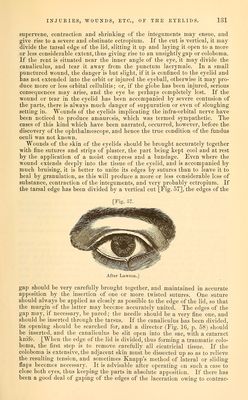
![of the right upper lid, and dense cicatrization of the fskiu of the forehead, from a burn in childhood. The piece of skin was taken from the inner aspect of the right forearm, and measured three and one-eighth inches in length by one and three-eighths in breadth. Three months after the opera- tion the effect was excellent. (See Trans. Amer. Ophthal. Soc, 1880. See also articles on Blepharoplasty, in the Lancet, April 17, 1880; Bull, et mem. de la Soc. de Chirurgie, April 5, 1880.)—B.] 15.—INJUKIES, WOUNDS, ETC., OF THE EYELIDS. Ecchymosis of the eyelids is of frequent occurrence, being chiefly the con- sequence of a severe blow or fall upon the eye, and is hence often met with in pugilistic encounters. It is due to a sanguineous effusion into the areolar tissue of the eyelids, which gives rise to a dark, livid discoloration, com- monly termed black-eye. As a rule, it occurs within a few hours after the accident; it may, however, come on at (mce, the discoloration extending from the eyelids to the neighboring parts. These facts distinguish this form of ecchymosis from that which is due to a counter-fracture of the orbit, for then the reverse obtains, the discoloration shows itself after a much longer interval, and gradually extends to the eyelids. Together with the effusion of blood into the areolar tissue of the lids, there is often much serous infil- tration and swelling of the latter and of the surrounding parts, the lids being perhaps so swollen that the eye is firmly closed. The discoloration is at first dark and livid, but gradually undergoes various changes of tint, turning bluish-red, green, yellow, etc. A black-eye generally disappears in two or three weeks' time, but the absorption of blood may be accelerated by various local i-emedies. Directly after the injury, compresses of lint dipped in ice- cold water should be applied, and very frequently changed, being retained in position by a firm bandage. This application of a cold compress tends greatly to limit the effusion of blood. The absorption of the latter is subse- quently much hastened by the continuous application of a firm bandage, together with which an evaporating lotion should be employed. Of the two, the bandage will, however, be found to render the greater service in acceler- ating the absorption. The tincture of arnica has long enjoyed a great and special reputation for curing black-eyes. It should be employed as a lotion (tr. arnicixj mont. f 3ij, ad aq. dest., or mist, camphor, f 5iv), A compress of lint is to be soaked in this, and applied to the lids by a firm bandage. The following formula, recommended by Mr. Lawson, is also a very good one: B. Tr. arnic. mont. f 3iv ; Liq. amnion, acet. f 5 j ; Sp. rosniarini f 3iv ; Mist, camph. ad fsviij.—M. f lotio. A poultice of black bryouy-root is likewise much in vogue amongst the public. The swollen parts should never be pricked or punctured, as this tends to produce suppuration and erysipelas. Wounds of the eyelkU vary in danger according to their situation and extent, and according to the fact whether they are simply incised, or are punctured, and accompanied perhaps by considerable bruising and contusion of the parts. If the incision is superficial and horizontal, and has only divided the skin and a few of the fibres of the orbicularis, it will soon heal by first intention, if the edges of the wound are brought together by sutures and strips of plaster, and little, if any, mark will be left behind. But when the wound is extensive, and has penetrated deeply into the upper lid, impli- cating perhaps the tarsus, and dividing the fibres of the levator palpebne, its consequences are much more serious. For not only may it produce a con- siderable degree of ptosis, but, on account of the suppuration which may](https://iiif.wellcomecollection.org/image/b20999392_0124.jp2/full/800%2C/0/default.jpg)
 No text description is available for this image
 No text description is available for this image
 No text description is available for this image