A treatise on the diseases of the eye / By J. Soelberg Wells... Together with selections from the test-types of Prof. E. Jaeger and Prof. H. Snellen.
- Wells, J. Soelberg (John Soelberg), -1879
- Date:
- 1883
Licence: Public Domain Mark
Credit: A treatise on the diseases of the eye / By J. Soelberg Wells... Together with selections from the test-types of Prof. E. Jaeger and Prof. H. Snellen. Source: Wellcome Collection.
Provider: This material has been provided by the Harvey Cushing/John Hay Whitney Medical Library at Yale University, through the Medical Heritage Library. The original may be consulted at the Harvey Cushing/John Hay Whitney Medical Library at Yale University.
31/898 page 37
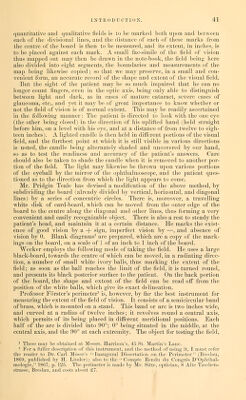
![ering how priceless would be the power of accurately estimating it hy the touch va. the case of various head affections. For the examination of the acuteness of vision [which means the power of distinguishing form.—B.] various test-types are used, more especially those of Jaeger and Snellen. The former do not, however, afford a perfect clue to the acuteness of vision, for a person may be able to read No. 1 of Jaeger with facility and yet not enjoy a normal acuteness of sight. Snellen has, however, devised a set of test-types which fulfil this desideratum. The letters are square, and their size increases at a definite ratio, so that each number is seen at an angle of five minutes. Thus, No. 1 is seen by a normal eye up to a distance of one foot, at an angle of five minutes, ISTo. 2 up to two feet, and so on. These numbers cannot, as a rule, be seen distinctly beyond these distances.^ [As commonly used, the term aaideness of vision is confined to vision at the centre of the visual field, for the periphery of the retina has only an imperfect power of distinguishing the shape and size of objects.^B.] Now, if the eye is sufiering from any diminution of acuteness of vision, it will require to see the letters under a larger angle than that of five min- utes, in order to gain larger retinal images. No. 1 cannot be read at a distance of one foot, but only, perhaps. No. 4 or 5. We may easily calculate the degree of the acuteness of vision thus: The utmost distance at which the types are recognized (d) divided by the distance at which they appear at an angle of five minutes (D), gives.the formula for the acuteness of vision (V): V == - • If d and D be found equal, and No. 20 be thus visible at a distance of 20 twenty feet, then V = — = 1; in other words, there is normal acuteness of vision. If, on the contrary, d be less than D, and if No. 20 is only visible within ten feet. No. 10 only within two feet, No. 6 only within one foot, these three cases are thus respectively expressed : V=i» = l;V = l = l;V = i 20 2 10 5 6 d may sometimes be greater than D, and No. 20 be visible at a greater distance than twenty feet. lu this case vision is more acute than the normal average. [This condition, as a matter of experience, is not at all uncom- mon, not only in hypermetropic eyes, but in emmetropic eyes.—B.] It must, however, be confessed that some patients (more especially amongst the lower classes) often experience a difficulty in fluently reading type composed of these square letters. They have always been accustomed to ordinary type, the letters of which are of unequal thickness, and differ both in dimensions and definition. I, therefore, generally employ Jaeger's test- types for ascertaining the fluency with which small print can be read, and 1 At Professor Longmore's suggestion, Dr. Snellen has given in his second edition of the test-types some tables containing a series of figures and single nvimbers for the examination of such recruits for the British Army as are unable to read. For further information as to the examination of the sight of recruits, I must refer the reader to Professor Longmore's excellent Ophthalmic Manual, which I would also recom- mend to the special notice of the surgeons of the Militia and Volunteer Corps. These test-types may be obtained at Messrs. Williams & Norgate's, Henrietta Street, Covent Garden. [A selection from the test-types of both .Jaeger and Snellen, sufiicient for use in ordinary practice, will be found at the end of this volume.—H.]](https://iiif.wellcomecollection.org/image/b20999392_0031.jp2/full/800%2C/0/default.jpg)
 No text description is available for this image
 No text description is available for this image
 No text description is available for this image