A treatise on the diseases of the eye / By J. Soelberg Wells... Together with selections from the test-types of Prof. E. Jaeger and Prof. H. Snellen.
- Wells, J. Soelberg (John Soelberg), -1879
- Date:
- 1883
Licence: Public Domain Mark
Credit: A treatise on the diseases of the eye / By J. Soelberg Wells... Together with selections from the test-types of Prof. E. Jaeger and Prof. H. Snellen. Source: Wellcome Collection.
Provider: This material has been provided by the Harvey Cushing/John Hay Whitney Medical Library at Yale University, through the Medical Heritage Library. The original may be consulted at the Harvey Cushing/John Hay Whitney Medical Library at Yale University.
41/898 page 47
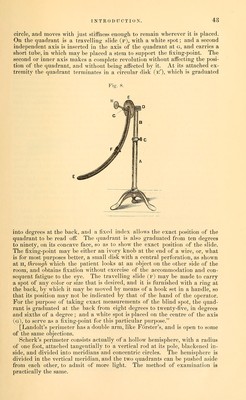
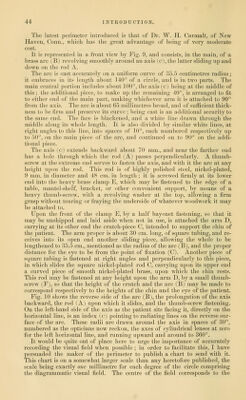
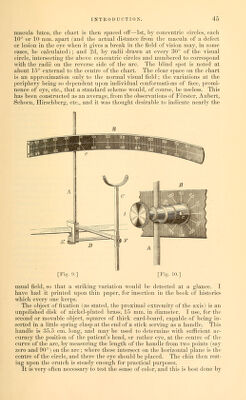
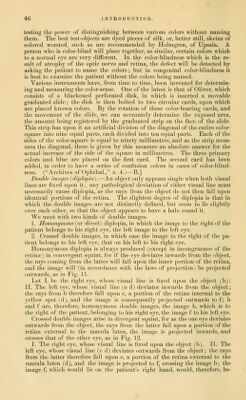
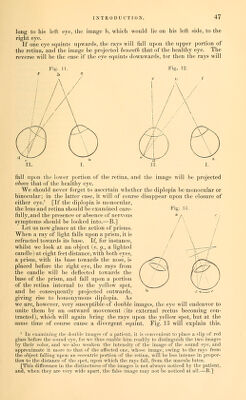
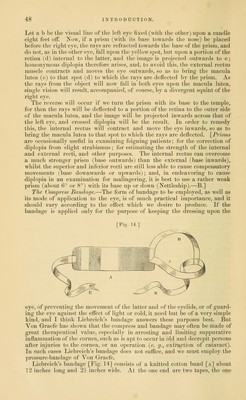
![long to his left eye, the image b, which would lie ou his left side, to the right eye. If one eye squints upwards, the rays will fall upon the upper portion of the retina, and the image be projected heneaih that of the healthy eye. The reverse will be the case if the eye squints downwards, for then the rays will Fie. 13. fall upon the lower portion of the retina, and the image will be projected above that of the healthy eye. We should never forget to ascertain whether the diplopia be monocular or binocular; in the latter case, it will of course disappear upon the closure of either eye.^ [If the diplopia is monocular, the lens and retina should be examined care- fully, and the presence or absence of nervous symptoms should be looked into.—B.] Let us now glance at the action of prisms. When a ray of light falls upon a prism, it is refracted towards its base. If, for instance, whilst we look at an object (e. g., a lighted candle) at eight feet distance, wdth both eyes, a prism, with its base towards the nose, is placed before the right eye, the rays from the candle will be deflected towards the base of the prism, and fall upon a portion of the retina internal to the yellow spot, and be consequently projected outwards, giving rise to homonymous diplopia. As we are, however, very susceptible of double images, the eye will endeavor to unite them by an outw'ard movement (its external rectus becoming con- tracted), which will again bring the rays upon the yellow spot, but at the same time of course cause a divergent squint. Fig. 13 will explain this. ^ In examining the double images of a patient, it is convenient to place a slip of red glass before the sound eye, for we thus enable him readily to distinguish the two images by their color, and we also weaken the intensity of the image of the sound eye, and approximate it more to that of the affected one, Avhose image, owing to the rays from the object falling upon an eccentric portion of the retina, will be less intense in propor- tion to the distance of the spot, upon which the rays fall, from the macula lutea. [This difference in the distinctness of the images is not always noticed by the patient, and, when they are very wide apart, the false image may not be noticed at all.—B.]](https://iiif.wellcomecollection.org/image/b20999392_0041.jp2/full/800%2C/0/default.jpg)
 No text description is available for this image
 No text description is available for this image
 No text description is available for this image