A systematic handbook of volumetric analysis, or, The quantitative estimation of chemical substances by measure, applied to liquids, solids, and gases : adapted to the requirements of pure chemical research, pathological chemistry, pharmacy, metallurgy, manufacturing chemistry, photography, etc., and for the valuation of substances used in commerce, agriculture and the arts / by Francis Sutton.
- Francis Sutton
- Date:
- 1882
Licence: Public Domain Mark
Credit: A systematic handbook of volumetric analysis, or, The quantitative estimation of chemical substances by measure, applied to liquids, solids, and gases : adapted to the requirements of pure chemical research, pathological chemistry, pharmacy, metallurgy, manufacturing chemistry, photography, etc., and for the valuation of substances used in commerce, agriculture and the arts / by Francis Sutton. Source: Wellcome Collection.
Provider: This material has been provided by University of Bristol Library. The original may be consulted at University of Bristol Library.
374/508 page 358
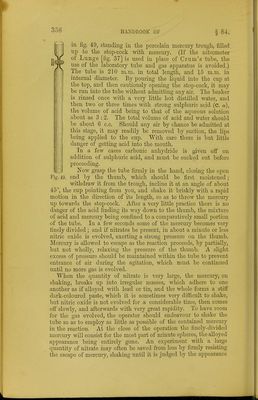
![ill fig. 49, standing in the porcelain mercury trough, filled. \\p to the stop-cock with mercury. (If the nitrometer of L unge [fig. 37] is used in place of Crum's tube, the use of the laboratory tube and gas apparatus is avoided.) The tube is 210 ni.m. in total length, and 15 ni.m. in internal diameter. By pouring the liquid into the cup at the top, and then cautiously opening the stop-cock, it may be run into the tube without admitting any air. The beaker is rinsed once with a very little hot distilled water, and then two or three times with strong sulphuric acid (c. a), the volume of acid being to that of the aqueous solution about as 3:2. The total volume of acid and water should be about 6 c.c. Should any air by chance be admitted at this stage, it may readily be removed by suction, the lips being applied to the cup. With care there is but little danger of getting acid into the mouth. In a few cases carbonic anhydride is given off on addition of sulphuric acid, and must be sucked out before proceeding. Now grasp the tube firmly in the hand, closing the open Fig. 49. end by the thumb, which should be first moistened; withdraw it from the trough, incline it at an angle of about 45°, the cup pointing from you, and shake it briskly with a rapid motion in the direction of its length, so as to throw the mercury up towards the stop-cock. After a very little practice there is no danger of the acid finding its way down to the thumb, the mixture of acid and mercury being confined to a comparatively small portion of the tube. In a few seconds some of the mercury becomes very finely divided; and if nitrates be present, in about a minute or less nitric oxide is evolved, exerting a strong pressure on the thumb. Mercury is allowed to escape as the reaction proceeds, by partially, but not wholly, relaxing the pressure of the thumb. A slight excess of pressure should be maintained within the tube to prevent entrance of air during the agitation, which must be continued until no more gas is evolved. When the quantity of nitrate is very large, the mercury, on shaking, breaks up into irregular masses, which adhere to one another as if alloyed with lead or tin, and the whole forms a stiff dark-coloured paste, which it is sometimes very difiicult to shake, but nitric oxide is not evolved for a considerable time, then comes off slowly, and afterwards with very great rapidity. To have room for the gas evolved, the operator should endeavour to shake the tube so as to employ as little as possible of the contained mercury in the reaction. At the close of the operation the iincl^'-divided mercury will consist for the most part of minute spheres, the alloyed appearance ))eing entirely gone. An experiment with a large quantity of nitrate inay often be saved from loss by firmly resisting the escape of mercury, shaking until it is judged by the appearance](https://iiif.wellcomecollection.org/image/b21443658_0374.jp2/full/800%2C/0/default.jpg)