A systematic handbook of volumetric analysis, or, The quantitative estimation of chemical substances by measure, applied to liquids, solids, and gases : adapted to the requirements of pure chemical research, pathological chemistry, pharmacy, metallurgy, manufacturing chemistry, photography, etc., and for the valuation of substances used in commerce, agriculture and the arts / by Francis Sutton.
- Francis Sutton
- Date:
- 1882
Licence: Public Domain Mark
Credit: A systematic handbook of volumetric analysis, or, The quantitative estimation of chemical substances by measure, applied to liquids, solids, and gases : adapted to the requirements of pure chemical research, pathological chemistry, pharmacy, metallurgy, manufacturing chemistry, photography, etc., and for the valuation of substances used in commerce, agriculture and the arts / by Francis Sutton. Source: Wellcome Collection.
Provider: This material has been provided by University of Bristol Library. The original may be consulted at University of Bristol Library.
376/508 page 360
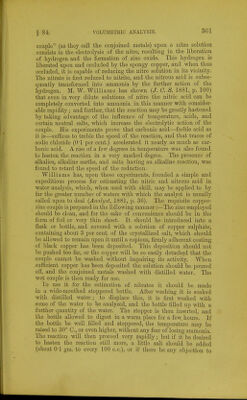
![7. Estimation of Nitrogen as Nitrates and Nitrites in Waters containing a very large quantity of Soluble Matter, with but little Ammonia or Organic Nitrogen. When the quantity of sohible matter is excessive, as, for example, in sea-water, the preceding method is inapplicable, as the solution to be employed cannot be reduced to a sufficiently small bulk to go into the shaking tube. If the quantity of organic nitrogen be less than O'l part in 100,000, the nitrogen as nitrates and nitrites may generally be determined by the following modification of Schulze's method, devised by E. T. Chapman. To 200 c.c. of the water add 10 c.c. of sodic hydrate solution (c. e), and boil briskly in an open porcelain dish until it is reduced to about 70 c.c. When cold pour the residue into a tall glass cylinder of about 120 c.c. capacity, and rinse the dish with water free from ammonia. Add a piece of aluminium foil of about 15 sq. centim. area, loading it Avith a piece of clean glass rod to keep it from floating. Close the mouth of the cylinder with a cork, bearing a small tube filled Avith pumice (c. ^) moistened with hydric chloride free from ammonia (c. t]). Hydrogen will speedily be given off from the surface of the aluminium, and in five or six hours the whole of the nitrogen as nitrates and nitrites will be converted into ammonia. Transfer to a small retort the contents of the cylinder, together with the ljumice, washing the whole apparatus with a little water free from ammonia. Distil, and estimate ammonia in the usual Avay with l^essler solution. It appears impossible AvhoUy to exclude ammonia from the re-agents and apparatus, and therefore some blank experiments should be made to ascertain the correction to be applied for this. This correction is very small, and appears to be nearly constant, 8. Estimation of Nitrogen as Nitrates and Nitrites by the Indigo Process, This method has been fully described in § 67,7. 9. Estimation of Nitrates as Ammonia by the Copper-zinc Couple, It is Avell known that when zinc is immersed in copper sulphate solution it becomes covered with a spongy deposit of i^recipitated copper. If the solution of copper sulphate be sufficiently dilute, this deposit of copper is black in colour, and firmly adherent to the zinc. It is, however, not so generally known that the zinc upon which copper has thus been deposited possesses the power of de- composing pure distilled water at the ordinary temperature, and that it is capable of efiecting many other decompositions which zinc alone cannot. Among these is the decomposition of nitrates, and the transformation of the nitric acid into, ammonia. Gladstone and Tribe have shown that the action of the copper-zinc](https://iiif.wellcomecollection.org/image/b21443658_0376.jp2/full/800%2C/0/default.jpg)