A systematic handbook of volumetric analysis, or, The quantitative estimation of chemical substances by measure, applied to liquids, solids, and gases : adapted to the requirements of pure chemical research, pathological chemistry, pharmacy, metallurgy, manufacturing chemistry, photography, etc., and for the valuation of substances used in commerce, agriculture and the arts / by Francis Sutton.
- Francis Sutton
- Date:
- 1882
Licence: Public Domain Mark
Credit: A systematic handbook of volumetric analysis, or, The quantitative estimation of chemical substances by measure, applied to liquids, solids, and gases : adapted to the requirements of pure chemical research, pathological chemistry, pharmacy, metallurgy, manufacturing chemistry, photography, etc., and for the valuation of substances used in commerce, agriculture and the arts / by Francis Sutton. Source: Wellcome Collection.
Provider: This material has been provided by University of Bristol Library. The original may be consulted at University of Bristol Library.
403/508 page 387
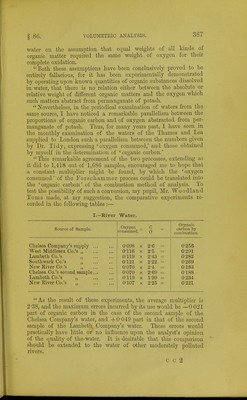
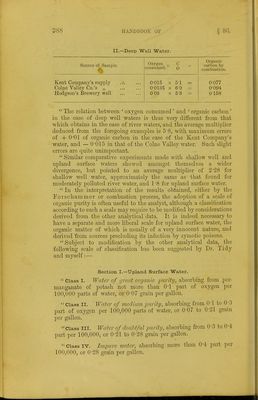
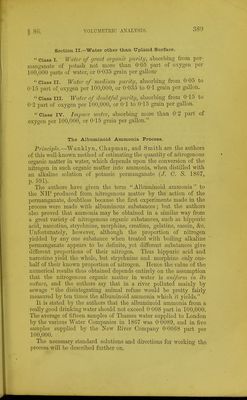
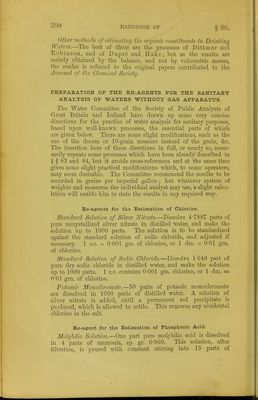
![water on the assumption tliat equal weights of all kinds of organic matter required the same weight of oxygen for their complete oxidation. Eoth these assumptions have been conclusively proved to be entirely fallacious, for it has been experimentally demonstrated by operating upon known quantities of organic substances dissolved in water, that there is no relation either between the absolute or relative weight of different organic matters and the oxygen which such matters abstract from permanganate of potash. ]Severtheless, in the periodical examination of waters from the same source, I have noticed a remarkable parallelism between the proportions of organic carbon and of oxygen abstracted from per- manganate of potash. Thus, for many years past, I have seen in the monthly examination of the waters of the Thames and Lea supplied to London such a parallelism between the numbers given by Dr. Tidy, expressing 'oxygen consumed,' and those obtained by myself in the determination of ' organic carbon.' This remarkable agreement of the two processes, extending as it did to 1,418 out of 1,G86 samples, encouraged me to hope that a constant multiplier might be found, by Avhicli the ' oxygen consumed' of the Forschammer process could be translated into the ' organic carbon' of the combustion method of analysis. To test the possibility of such a conversion, my pupil, Mr. Woodland Toms made, at my suggestion, the comparative experiments re- corded in the following tables :— I.—River Water. Source of Sample. Oxygen consumed. c 0 Organic carl)on hy combustion. Chelsea Company's supply West Middlesex Co.'s „ 0-098 X 2-6 = 0-256 0116 X 2-5 = 0-291 Lambeth Co.'s „ 0119 X 2-43 = 0-282 Southwark Co.'s „ 0121 X 2-22 = 0269 New Elver Co.'s „ 0-076 X 2-4 = 0-183 Chelsea Co.'s second sample 0-070 X 2-69 0-188 Lambeth Co.'s „ 0-119 X 1-99 = 0-234 New Eiver Co.'s „ 0-107 X 2-25 = 0-221 As the result of these experiments, the average multiplier is 2'38, and the maximum errors incurred by its use would be —0-021 part of organic carbon in the case of the second sample of the Chelsea Company's water, and -}-0-04-9 part in that of the second sample of the Lambeth Company's water. Those errors would practically have little or no iniluencc upon the analyst's opinion of the (piality of tho-water. It is desirable that this comparison should be extended to the water of o-thcr moderately polluted rivers. C G 2](https://iiif.wellcomecollection.org/image/b21443658_0403.jp2/full/800%2C/0/default.jpg)