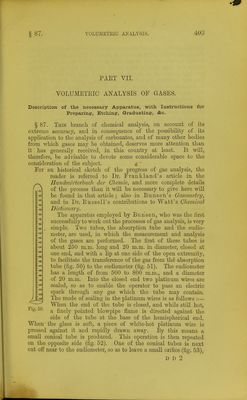
A systematic handbook of volumetric analysis, or, The quantitative estimation of chemical substances by measure, applied to liquids, solids, and gases : adapted to the requirements of pure chemical research, pathological chemistry, pharmacy, metallurgy, manufacturing chemistry, photography, etc., and for the valuation of substances used in commerce, agriculture and the arts / by Francis Sutton.
- Francis Sutton
- Date:
- 1882
Licence: Public Domain Mark
Credit: A systematic handbook of volumetric analysis, or, The quantitative estimation of chemical substances by measure, applied to liquids, solids, and gases : adapted to the requirements of pure chemical research, pathological chemistry, pharmacy, metallurgy, manufacturing chemistry, photography, etc., and for the valuation of substances used in commerce, agriculture and the arts / by Francis Sutton. Source: Wellcome Collection.
Provider: This material has been provided by University of Bristol Library. The original may be consulted at University of Bristol Library.
417/508 page 401
![of the water in a flask briskly for half an hour, adding distilled water from time to time to make up for loss by evaporation. It is not desirable to boil the water under a vertical condenser, as the dissolved carbonic acid is not so freely liberated. At the end of half an hour, allow the water to cool, the mouth of the flask being closed; make the water up to its original volume with recently boiled distilled water, and, if possible, decant the quantity necessary for testing. If this cannot be done quite clear, it must be filtered. Conduct the test in the same manner as described above. The hardness is to be returned in each case--to the nearest half- degree. Total Solid Matters.—Evaporate 250 c.c, or -gLth of a gallon, in a weighed platinum dish on a water bath; dry the residue at 220 F. (104° C), and cool under a dessicator. Weigh the dish con- taining the residue accurately, and note its colour and appearance, and especially whether it rapidly increases in weight. Eeturu to the water bath for half an hour and re-weigh until it ceases to lose weight, then gradually heat it to redness, and note the changes which take place during this ignition. Especially among these changes should be observed the smell, scintillation, change of colour, separation of more or less carbon, and partial fusion, if any. The ignited residue is to be used for the estimation of phosphoric acid, as before directed. Microscopical Examination of Deposit.—The luost convenient plan of collecting the deposit is to place a circular microscopical cover- ing glass at the bottom of a large conical glass holding about 20 oz. The glass should have no spout, and should be ground smooth on the top. After shaking up the sample, this vessel is filled with the water, covered with a plate of ground glass and set aside to settle. After settling, the supernatant water is drawn off by a fine syphon, and the glass bearing the deposit lifted out, either by means of a platinum wire (which should have been previously passed under it), or in some other convenient way, and inverted on to an ordinary microscopical slide for examination. It is desirable to examine the deposit first by a -^th and then by a ith objective. The examina- tion should be made as soon as the water has stood overnight. If the water be allowed to stand longer, organisms peculiar to stagnant water may be developed and mislead the observer. Particular notice should be taken of bacteria, infusoria, ciliata or flagellata, disintegrated fibres of cotton, or linen, or epithelial debris. It is particularly desirable to report clearly on this microscopical examination; not merely giving the general fact that organisms Avere present, but stating as specifically as possible the names or classes of the organisms, so that more data may be obtained for the application of the examination of this deposit to the characters of potable waters. 1) ])](https://iiif.wellcomecollection.org/image/b21443658_0417.jp2/full/800%2C/0/default.jpg)