A systematic handbook of volumetric analysis, or, The quantitative estimation of chemical substances by measure, applied to liquids, solids, and gases : adapted to the requirements of pure chemical research, pathological chemistry, pharmacy, metallurgy, manufacturing chemistry, photography, etc., and for the valuation of substances used in commerce, agriculture and the arts / by Francis Sutton.
- Francis Sutton
- Date:
- 1882
Licence: Public Domain Mark
Credit: A systematic handbook of volumetric analysis, or, The quantitative estimation of chemical substances by measure, applied to liquids, solids, and gases : adapted to the requirements of pure chemical research, pathological chemistry, pharmacy, metallurgy, manufacturing chemistry, photography, etc., and for the valuation of substances used in commerce, agriculture and the arts / by Francis Sutton. Source: Wellcome Collection.
Provider: This material has been provided by University of Bristol Library. The original may be consulted at University of Bristol Library.
455/508 page 439
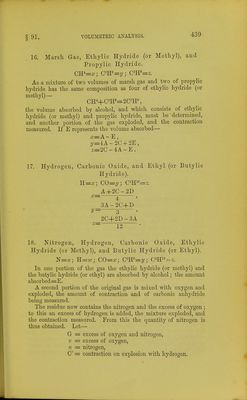
![16. Marsh Gas, Ethylic Hydride (or Methyl), and Propylic Hydride. CW=x; C-W=y; Cm'=z. As a mixture of two vohimes of marsh gas and two of propylic hydride has the same composition as four of ethylic hydride (or methyl)— CH^+OT=2C^H% the volume ahsorbed by alcohol, and which consists of ethylic hydride (or methyl) and propylic hydride, must he determined, and another portion of the gas exploded, and the contraction measured. If E represents the volume absorbed— a;=A-E, y=4:A - 2C + 2E, ;!;=2C-4A-E. 17. Hydrogen, Carbonic Oxide, and Ethyl (or Butylic Hydride). B.=x', CO=jj; C^Hi»=.?. A + 2C-2D ^= i , 3A-2C+D y= 3 , 2C4-2D - 3A 18. Nitrogen, Hydrogen, Carbonic Oxide, Ethylic Hydride (or Methyl), and Butylic Hydride (or Ethyl). ]S'=n; K=w; CO=x; C-W=^y; (m''> = z. In one portion of the gas the ethylic hydride (or methyl) and the butylic hydride (or ethyl) are absorbed by alcohol; the amount absorbed=E. A second portion of the original gas is mixed with oxygen and exploded, the amount of contraction and of carbonic anhydride being measured. The residue now contains the nitrogen and the excess of oxygen; to this an excess of liydrogen is added, the mixture exploded, and the contraction measured. From this the quantity of nitrogen is thus obtained. Let— G = excess of oxygen and nitrogen, V = excess of oxygen, 71 = nitrogen, C = contraction on explosion with hydrogen.](https://iiif.wellcomecollection.org/image/b21443658_0455.jp2/full/800%2C/0/default.jpg)