A systematic handbook of volumetric analysis, or, The quantitative estimation of chemical substances by measure, applied to liquids, solids, and gases : adapted to the requirements of pure chemical research, pathological chemistry, pharmacy, metallurgy, manufacturing chemistry, photography, etc., and for the valuation of substances used in commerce, agriculture and the arts / by Francis Sutton.
- Francis Sutton
- Date:
- 1882
Licence: Public Domain Mark
Credit: A systematic handbook of volumetric analysis, or, The quantitative estimation of chemical substances by measure, applied to liquids, solids, and gases : adapted to the requirements of pure chemical research, pathological chemistry, pharmacy, metallurgy, manufacturing chemistry, photography, etc., and for the valuation of substances used in commerce, agriculture and the arts / by Francis Sutton. Source: Wellcome Collection.
Provider: This material has been provided by University of Bristol Library. The original may be consulted at University of Bristol Library.
476/508 page 460
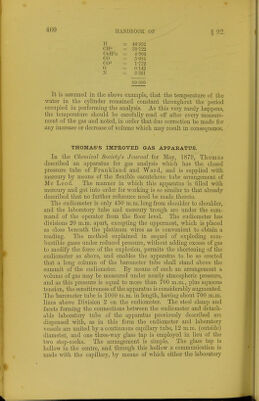
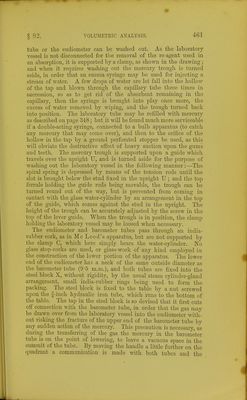
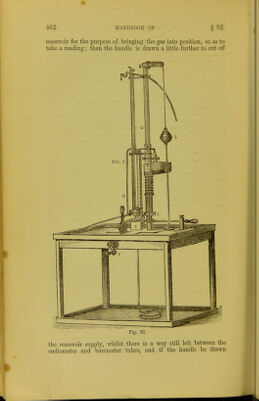
![§92. H CH^ 46-952 38-122 4- 966 5- 684 1- 772 0-142 2- 361 Cnl-I^ii CO C02 0 N 99-999 It is assumed in the above example, that the temperature of the water in the cylinder remained constant throughout the period occupied in performing the analysis. As this very rarely happens, the tem]Derature should be carefully read otf after every measure- ment of the gas and noted, in order that due correction be made for any increase or decrease of volume which may result in consequence, In the Chemical Societifs Journal for May, 1870, Thomas described an apparatus for gas analysis which has the closed pressure tube of Frankland and Ward, and is supplied with inercury by means of the flexible caoutchouc tube arrangement of Mc Leod. The manner in which this apparatus is filled Avith mercury and got into order for working is so similar to that already described that no further reference need be made thereto. The eudiometer is only 450 m.m. long from shoulder to shoulder, and the laboratory tube and mercury trough are imder the com- mand of the operator from the floor level. The eudiometer has divisions 20 m.m. apart, excepting the uppermost, which is placed as close beneath the platinum Avires as is convenient to obtain a reading. The method explained in sequel of exploding com- bustible gases imder reduced pressure^ without adding excess of gas to modify the force of the explosion, permits the shortening of the eudiometer as above, and enables the apparatus to be so erected that a long column of the barometer tube shall stand above the summit of the eudiometer. By means of such an arrangement a volume of gas may be measured under nearly atmospheric pressure, and as this pressure is equal to more than 700 m.m., plus aqueous tension, the sensitiveness of the apparatus is considerably augmented. The barometer tube is 1000 m.m. in length, having about 700 m.m. lines above Division 2 on the eudiometer. The steel clamp and facets forming the connections between the eudiometer and detach- able laboratory tube of the apparatus previously described are dispensed with, as in this form the eudiometer and laboratory vessels are united by a continuous capillary tube, 12 m.m. (outside) diameter, and one three-way glass tap is employed in lieu of the two stop-cocks. The arrangement is simple. The glass tap is hollow in the centre, and through this hollow a communication is made with the capillary, by means of which either the laboratory THOMAS'S IMPROVED GAS APPARATUS.](https://iiif.wellcomecollection.org/image/b21443658_0476.jp2/full/800%2C/0/default.jpg)