Licence: In copyright
Credit: The plant alkaloids / by Thomas Anderson Henry. Source: Wellcome Collection.
Provider: This material has been provided by the Royal College of Physicians of Edinburgh. The original may be consulted at the Royal College of Physicians of Edinburgh.
32/506 page 20
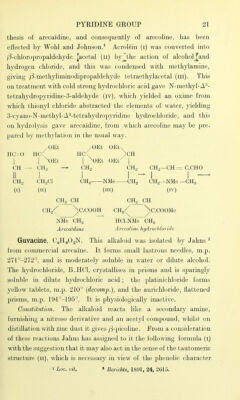
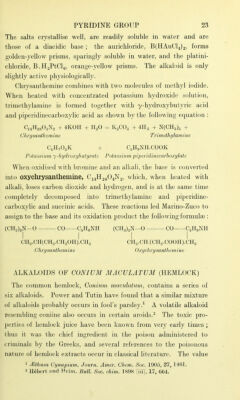
![chloride, B.HA11CI4, yellow prismatic crystals, m.p. 186°-187°, and the platinichloride, [B.HCl]2.PtGl4, m.p. 213°-214°, orange octa- hedra, are both characteristic. It is formed from guvacine {see helow) when that alkaloid is treated with sodium methoxide and potassium methyl sulphate, and is probably N-methylguvacine. It is physiologically inactive. Arecoline, CgH^gOaN, is a colourless strongly alkaline liquid, b.p. 220°, miscible with water and most organic solvents in all proportions. It is extracted from water by ether only in presence of salts in solution. It furnishes crystalline, but usually deliques- cent salts ; the hydrobromide, B.HBr, forms slender prisms, m.p, 167°-168° from alcohol; the aurichloride, B.HAUCI4, is an oil, but the platinichloride, [B.HCl]2.PtCl4, m.p. 176°, crystallises from water in orange-red rhombs. The methiodide forms glancing prisms, m.p. 173°-174°. Arecoline and its salts are highly toxic. According to Meier it belongs to the nicotine-pilocarpine group and acts on the central and peripheral parts of the nervous system, producing paralysis, which may be preceded by convulsions. With nicotine the central action is the more marked, and with pilocarpine the peripheral. With arecoline the two are about equal.^ Arecoline hydro- bromide is recognised in several Continental pharmacopoeias, being used as a sialogogiie and diaphoretic. It has also been used like physostigmine to produce myosis. When heated with hydrochloric or hydriodic acid, or by the action of alkalis, arecoline yields arecaidine and methyl chloride, iodide or hydroxide, depending on the hydrolytic agent used. Further, on esterification with methyl alcohol arecaidine yields arecoline, so that the latter must be the methyl ester of arecaidine {see above). The ethyl ester has been prepared and is known as homoarecoline ; it closely resembles arecoline, and, like it, is poisonous. The partial synthesis of arecaidine from potassium nicotinate as a starting-point has been described already. A complete syn- ‘ Bio-Chem. Zeit. 1907, 2, 415.](https://iiif.wellcomecollection.org/image/b2196189x_0032.jp2/full/800%2C/0/default.jpg)