Licence: In copyright
Credit: The plant alkaloids / by Thomas Anderson Henry. Source: Wellcome Collection.
Provider: This material has been provided by the Royal College of Physicians of Edinburgh. The original may be consulted at the Royal College of Physicians of Edinburgh.
35/506 page 23
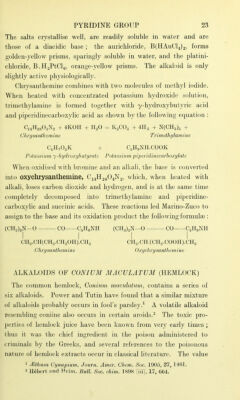
![The salts crystallise well, are readily soluble in water and are those of a diacidic base ; the aurichloride, B(HAuCl4)2, forms golden-yellow prisms, sparingly soluble in water, and the platini- chloride, B.K.^PtClg, orange-yellow prisms. The alkaloid is only slightly active physiologically. Chrysanthemine combines with two molecules of methyl iodide. When heated with concentrated potassium hydroxide solution, trimethylaniine is formed together with y-hydroxybutyric acid and piperidinecarboxylic acid as shown by the following equation : CuHagOgNo + 4KOH + H^O = K^COg + 4H;, + N(CH3)3 + Chrijtsaiiihemine Trimethijlaniine C4H7O3K + C5H9NH.COOK Potassium y-hydroxijbutijmte Potassium 'piperidmecarhoxylate When oxidised with bromine and an alkali, the base is converted into oxychrysanthemine, CijHaeO^Ng, which, when heated with alkali, loses carbon dioxide and hydrogen, and is at the same time completely decomposed into trimethylaniine and piperidine- carboxylic and succinic acids. These reactions led Marino-Zuco to assign to the base and its oxidation product the following formulae ; (CH3)3N—O CO CgHgNH (CH3)3N—0 CO CgHsNH CH2.CH(CH2.CHoOh|c4L CHo.CH.(CH2.COOH).CH2 Chrysanthemine Oxychrysanthemine ALKALOIDS OF CONIUM MACULATUM (HEMLOCK) The common hemlock, Conium niaculatum, contains a series of six alkaloids. Power and Tutin have found that a similar mixture of alkaloids probably occurs in fool’s parsley.’- A volatile alkaloid resembling coniine also occurs in certain aroids.^ The toxic pro- perties of hemlock juice have been known from very early times ; thus it was the chief ingredient in the poison administered to criminals by the Greeks, and several references to the poisonous nature of hemlock extracts occur in classical literature. The value 1 rEthusa Cynapium. Journ. Amer. Chem. Soc. 1905, 27, 1461. ^ Hebert and Heim, Bull. Soc. chim. 1898 [iii], 17, 664.](https://iiif.wellcomecollection.org/image/b2196189x_0035.jp2/full/800%2C/0/default.jpg)