Licence: In copyright
Credit: The plant alkaloids / by Thomas Anderson Henry. Source: Wellcome Collection.
Provider: This material has been provided by the Royal College of Physicians of Edinburgh. The original may be consulted at the Royal College of Physicians of Edinburgh.
38/506 page 26
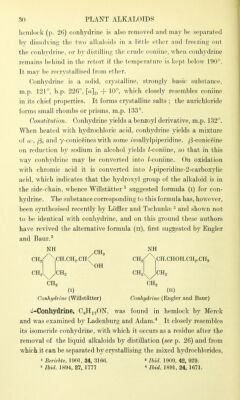
![the various parts of the plant have been investigated by Farr and Wright/ who find that the stem contains 0-01 to 0-06, leaves 0-03 to 0-18, flowers 0-086 to 0-236, and green fruit 0-725 to 0-975 per cent. The fruit, which is the part mostly used in medicine, appears to contain most alkaloid when from three-fourths to full grown. An examination of many commercial samples of the drug as imported into the United Kingdom in 1904 ^ showed that these contained percentages of alkaloid varying from 0-096 to 0-832, whereas English fruits collected by the authors yielded 1-05 to 3-57 per cent. Coniine, CgHj^N. This alkaloid was first isolated by Giesecke in 1827. For many years its formula was thought to be CgHijN, and its true composition was first demonstrated by Hofmann.^ Coniine is most readily obtained from crushed hemlock fruits by allowing these to stand with dilute sodium carbonate solution and steam-distilling the mixture. The distillate contains the mixed volatile alkaloids with ammonia. It is neutralised with hydrochloric acid, evaporated to dryness, and the dry residue extracted with alcohol, which dissolves the alkaloidal hydrochlorides and some ammonium chloride. The latter is removed by adding dry ether to the alcoholic solution. The residue left on evaporation of the alcohol-ether solution is dissolved in cold water, ether added, and the bases liberated by the addition of potash, and the whole shaken. The ethereal solution is dried with potassium carbonate and the ether distilled off at a low temperature, when the mixed alkaloids remain as an oily liquid. These may be separated to a certain extent by fractional distillation in a current of hydrogen, conhydrine being left as a residue if the temperature does not exceed 190°; the coniine and y-coniceine passing over together in the first fractions. For the separation of coniine from coniceine Wolffenstein recommends the conversion of the mixed bases into hydrochlorides. These are dried and extracted with acetone, ^ Pharm. Journ. [iv], 1, 89. Luc. cit. 1904 [iv], 18, 185. =* Berichtc, ISsl, 14, 705. ^ Ibid. 1894, 27, 2015.](https://iiif.wellcomecollection.org/image/b2196189x_0038.jp2/full/800%2C/0/default.jpg)