Licence: In copyright
Credit: The plant alkaloids / by Thomas Anderson Henry. Source: Wellcome Collection.
Provider: This material has been provided by the Royal College of Physicians of Edinburgh. The original may be consulted at the Royal College of Physicians of Edinburgh.
42/506 page 30
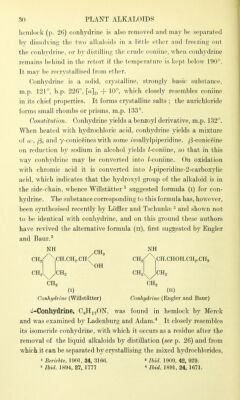
![lieralock (p. 2(>) conhydrine is also removed and may be separated by dissolving the two alkaloids in a little ether and freezing out the conhydrine, or by distilling the crnde coniine, when conhydrine remains behind in the retort if the temperature is kept below 190°. It may be recrystallised from ether. Conhydrine is a solid, crystalline, strongly basic substance, m.p. 121°, b.p. 226°, [a]^ + 10°, which closely resembles coniine in its chief properties. It forms crystalline salts ; the aurichloride forms small rhombs or prisms, m.p. 133°. Constitution. Conhydrine yields a benzoyl derivative, m.p. 132°. When heated with hydrochloric acid, conhydrine yields a mixture of f^, and y-coniceines with some tsoallylpiperidine. )3-coniceine on reduction by sodium in alcohol yields bconiine, so that in this way conhydrine may be converted into bconiine. On oxidation with chromic acid it is converted into bpiperidine-2-carboxylic acid, which indicates that the hydroxyl group of the alkaloid is in the side-chain, whence Willstatter ^ suggested formula (i) for con- hydrine. The substance corresponding to this formula has, however, been synthesised recently by Loffler and Tschunke ^ and shown not to be identical with conhydrine, and on this ground these authors have revived the alternative formula (ii), first suggested by Engler and Baur.^ NH CHs/ ^CH.CHg.CH/ NH CHa/^^CH.CHOH.CHs.CHs CHa^^CHa CHa CHa (I) (II) Conhydrine (Willstatter) Conhydrine (Engler and Baur) l-Conhydrine, CgHj^ON, was found in hemlock by Merck and was examined by Ladenburg and Adam.^ It closely resembles its isomeride conhydrine, with which it occurs as a residue after the removal of the liquid alkaloids by distillation [see p. 26) and from which it can be separated by crystallising the mixed hydrochlorides, ^ Berichte, 1901, 34, 3166. “ Ibid. 1909, 42, 929.](https://iiif.wellcomecollection.org/image/b2196189x_0042.jp2/full/800%2C/0/default.jpg)