Licence: In copyright
Credit: The plant alkaloids / by Thomas Anderson Henry. Source: Wellcome Collection.
Provider: This material has been provided by the Royal College of Physicians of Edinburgh. The original may be consulted at the Royal College of Physicians of Edinburgh.
51/506 page 39
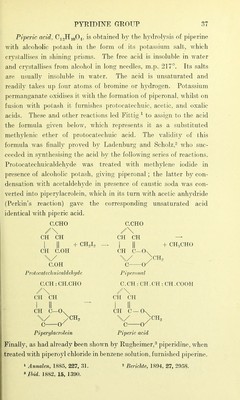
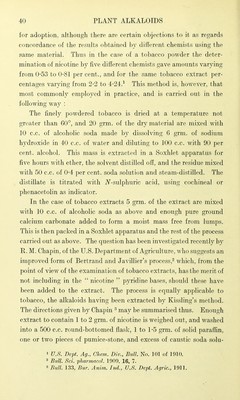
![Altogether four alkaloids have been isolated from tobacco : According to Pictet and Court pyrrolidine and 1-methylpyrroline also occur in tobacco. The quantity of total alkaloids shows great variation, but does not as a rule exceed 6 per cent, in commercial tobacco, and averages about 4 per cent. In 1000 parts of total alkaloid Pictet and Rotschy found 20 of nicoteine, 5 of nicotimine, and 1 of nicotelline.^ For the isolation of the total alkaloids (commercial nicotine) the finely powdered tobacco leaves are exhausted with warm water and the extract concentrated, made alkaline by addition of a slight excess of lime or caustic soda, and steam-distilled. The distillate is neutralised, evaporated to a small bulk, made alkaline, and the liberated alkaloid shaken out with ether. The residue left after removal of the ether by distillation is dried in a current of hydrogen.^ Commercial nicotine is generally made from midribs of tobacco leaves which are removed in preparing tobacco for smoking. For use as an insecticide large quantities of “ tobacco extract,” which is merely an aqueous extract of waste tobacco, are manufactured, and this material is a convenient source of tobacco alkaloids. Estimation. Tobacco is no longer employed therapeutically, but its content of “ nicotine ” (total alkaloids) is important in ascer- taining the suitability of raw tobacco for the preparation of smoking tobacco, although this constituent is less important from this point of view than are the readiness with which the leaves burn, their aroma, content of moisture, &c. This estimation has also acquired great importance recently in view of the use of tobacco and tobacco extracts as agricultural insecticides. The Department of Agricul- ture of the United States of America some years ago instituted an inquiry into methods for the estimation of nicotine in tobacco, with the result that the process devised by Kissling ^ was recommended Nicotine, C]oHi4N2. Nicoteine, CioHi^Ng. Nicotimine, C10H44N2. Nicotelline, Ci^H8N2. ^ Berichfe, 1901, 34, 696. 2 Laiblin, Annalen, 1879, 196, 130. 3 Zeit. Anal. Cliem. 1882, 21, 64, 383 ; 1895, 34, 413; 1896, 35, 309, 731.](https://iiif.wellcomecollection.org/image/b2196189x_0051.jp2/full/800%2C/0/default.jpg)