Numeral systems of Mexico and Central America / by Cyrus Thomas.
- Cyrus Thomas
- Date:
- [1901]
Licence: In copyright
Credit: Numeral systems of Mexico and Central America / by Cyrus Thomas. Source: Wellcome Collection.
31/116 page 877
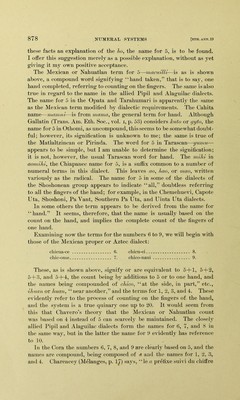
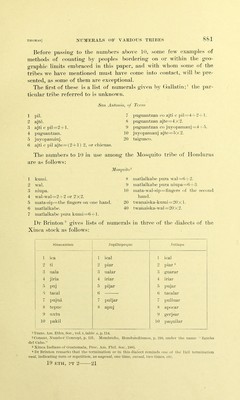
![numbers below 6 is not deemed of special interest in the present dis- cussion, which relates more directl}^ to the systems, we begin with 5d Ho oryo, the name for 5 in all the Mayan dialects (except the Huas- teca) when the affixes are ozuitted, is without any signification except as a numeral, so far as is now known, that seems to be appropriate to this use. Bancroft gives ‘‘entry,” as is stated above, but this, though one signitication of the term, has no apparent application here. If a guess be permissilzle, I would offer the following suggestion: In Stoll’s list for 5 we notice that the name for this number in Cakchiziuel is vuoo^ and for 1.5 in Quekchi is 'tmolahu^ and in Cakchicpiel mioJahuk (substituting the A fory). Now, as 6 is xmc^ or vuoh^ 7 uul\ c/zA, or 'tniuk^ and 8 xiaxak\ uaxol\ or vuaxak, is it not possible that ho or 0 is an abbreviation of a word beginning with xi, or vo, as //cV, which, in addition to its signification (as a verb) “to make round.” ‘‘to will.” also, according to Brasseur, signifies “filled up,” “full, entire,” etc.? Hendei’son, manuscript Maya-English dictionary, gives as another meaning ‘‘all in one,” “the gross amount,” and Beltran, Arte del Idioma Maya, states that in composition it sig’iiifies ‘‘todo junto,” which is substantially the same signification as that given by Brasseur. The term was also used, according to all the authorities, in counting round or solid things, as bundles of cotton, etc. As Perez informs us that the ancient foi'in of the word was hoi. it is possible that in ' It is to be hoped however, that Profe.ssor McGee, or some one who has given thouglit to the sub- ject, will carry forward these investigations, as the working out of the beginnings of counting, and the origin of the lower number names, will have an important bearing on some of the problems of ethnology and linguistics not yet comidetely ,solved. The field most likely to yield fruitful results is of course to be found in the languages and customs of the lower savage tribes. The more the rela- tion of 2 and 4 to one another is studied the more important becomes I’rofessor McGee's suggestion that these numbers represent the first two steps in many primitive counts. The statement by Conant, quoted in the preceding note, that the Australians in almost all cases count by pairs,” seems to be exactly in line with this stiggestion, Curr, to whom Conant refers as “ the best authority on this .subject, believes that where (among the Australians) a distinct word for 4 is given, investigators have been deceived in every case. This would seem to exidain the supposed use of pairs; the 2 was used in naming the 4. This tendehey, as indicated above in the text, is found in various dialects in widely separated countries. As a few examples we note the following: Betoya (_South America) Jiviros (South America) Bakairi (South Amer- ica) Torres Straits 2 cayapa 4 cajezea = 2 with plural termina- tion catu eiicatii asage astige-asage okosa okosa-okosji Mosquito (Central .\menca) Watchandies (South •Africa) Karankawa (Texas) 2 wal 4 wal-wal utauara atarra-marra haikaia hayo hakn=2x2 Many examples might be ])resented, but these will suffice to show how widely spread they are Australia and South .\merica being the regions of most frequent occurrence, and few examples being found in Polynesian dialects.](https://iiif.wellcomecollection.org/image/b24883694_0031.jp2/full/800%2C/0/default.jpg)




 No text description is available for this image
 No text description is available for this image
 No text description is available for this image