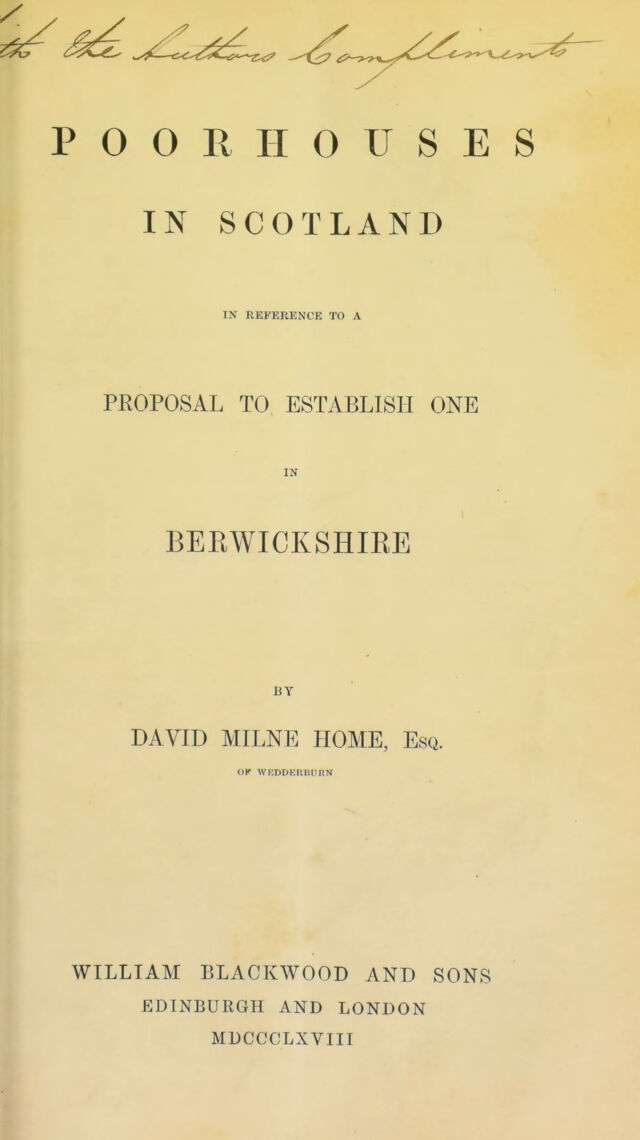
Poorhouses in Scotland in reference to a proposal to establish one in Berwickshire / by David Milne Home.
- Date:
- 1868
Licence: Public Domain Mark
Credit: Poorhouses in Scotland in reference to a proposal to establish one in Berwickshire / by David Milne Home. Source: Wellcome Collection.
Provider: This material has been provided by the Royal College of Physicians of Edinburgh. The original may be consulted at the Royal College of Physicians of Edinburgh.
17/36 page 15
![When the impotent poor are to be maintained, it is as necessary to provide them with a house to live in, as with food and clothing; and it would be a strange thing to redrain a Parochial Board from collecting in one home, the poor scattered through the parish Is any one of the legal poor entitled, as matter of right, to outdoor relief ] To that question I have no hesitation in giving the answer, That it is in all cases a legal tender of relief to offer admission to the Poorhouse. It has been said that the Workhouse was intended, under the provisions of the 8th and 9th Yict., only for a certain class of poor persons. That is to me quite a new proposition. The circumstances of the case in which this judgment was pronounced deserve to be noted, not only as showing the legal power possessed by Parochial Boards, but as illustrating the extent to which the power is likely to be used. The pauper, in the case referred to, had been postmaster iu a considerable fishing town, and a shoemaker by trade. Be- coming disabled for work, in consequence of scrofula, he applied to the Parochial Board for assistance. He was sixty-tive years old. He had no children, but he had an active and industrious wife, who gained some earnings for both her own and her hus- band s support. Tlie Parochial Board granted an allowance in these circumstances of 2s. per week, which was continued from the year 185.3 to the year 1865. In this last year, a Combination Poorhouse was erected in the county, but not in the parish to which the postmaster belonged, and in which parish he had resided all his life. The Parochial Board, having acquired right to send a certain number of paupers'to this Poorhouse, intimated to the old postmaster that his weekly allowance of 2s. was to cease, but that he might go to the Poorhouse. The postmaster declined to go, urging that he would have to leave his own cottage, where he lived comfort- ably enough with the 2s. a-week, and the help he got from his wife and neighbours; whereas, by going to the Poorhouse, he would be separated from them, and would for his maintenance cost the parish a great deal more than by allowing the outdoor relief to continue.* But the Parochial Board adhered to their * The expense of maintaining the inmates of the Nairn Combination Poor- house, which is the one referred to, was on an average 5s. 3|d. in the vear 1867,—in the year before, 5s. 74d.](https://iiif.wellcomecollection.org/image/b21962339_0017.jp2/full/800%2C/0/default.jpg)