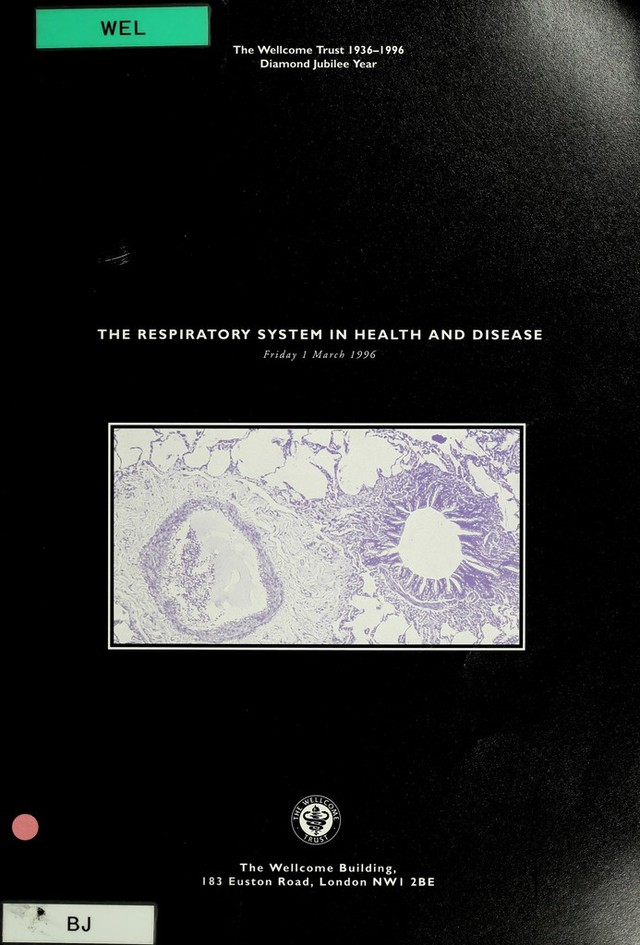
The respiratory system in health and disease : Friday March 1 1996 / The Wellcome Centre for Medical Science.
- Date:
- 1995
Licence: Public Domain Mark
Credit: The respiratory system in health and disease : Friday March 1 1996 / The Wellcome Centre for Medical Science. Source: Wellcome Collection.
21/140 page 13
![CELLULAR AND MOLECULAR MECHANISMS OF AIRWAY SMOOTH MUSCLE PROLIFERATION Stuart J Hirst, Peter J Barnes and Charles HC Twort* UMDS Department of Allergy and Respiratory Medicine, St Thomas' Hospital, London SEl 7EH *National Heart and Lung Institute, Dovehouse Street, London SW3 6LY Resistance to laminar flow in the peripheral airways is related inversely to the fourth power of the luminal radius. Small changes in airway lumen diameter cause profound increases in airway resistance to airflow. Increased contraction of airway smooth muscle (ASM) was thought to account for this reduction in airflow, but it is now well established that in chronic severe asthma increases in airway wall thickening due to an increase in the smooth muscle mass can, even in the absence of smooth muscle contraction, account for the irreversibility to bronchodilators and the bronchial hyperresponsiveness characteristic of severe asthma. The pathophysiological nature and source of the mediators controlling airway wall remodelling is unknown, and until very recently has received little attention.1 We have developed a model preparation of human bronchial smooth muscle cells in culture to study 2 the proliferative response. The effect of recombinant PDGF isoforms (PDGF-AA, -BB and -AB) on mitogenesis was examined using the MTT reduction assay and [3H] thymidine incorporation. We have also examined possible roles for protein kinase C (PKC) and protein tyrosine kinase (PTK) signalling pathways in PDGF-stimulated mitogenesis of human ASM cells. Results were correlated with expression of PDGF receptor (PDGFR) CX and fj subunits in the absence and presence of fetal calf serum (FGS). When FCS was absent PDGF-AB and -BB were potent mitogens, while PDGF-AA was weakly autogenic, evoking <20% of the maximum response induced by the B-chain isoforms. When FCS (2.5%) was present, all PDGF isoforms stimulated marked ASM proliferation with similar efficacy and potency. Cross-competition binding analysis in FCS-deprived cells revealed that ASM cells in culture express mainly PDGFRfi. Preincubation with PDGF-AA or PDGFRa neutralizing anti-serum abolished PDGF-AA binding and decreased total receptor number by -15%. The ratio of PDGFR a:(3 subunits was -1:8, supported by intense immunofluorescence staining for PDGFRP and weak staining for PDGFRa.3 In parallel studies uptake of [3H] thymidine stimulated by PDGF-AA, but not PDGF-AB or -BB, was inhibited by PDGFRa immobilization. Western immunoblots confirmed expression of mature PDGFRa and (3 subunits. FCS did not cause any detectable increase in PDGFRa expression or in PDGF-AA binding. The involvement of PKC- and PTK-dependent signalling events was examined using pharmacological inhibitors. The relative selectivity of each protein kinase inhibitor for its intended target enzyme was determined. Ro31-8220 (0.001-10pM; PKC inhibitor), but not ST638 (0.001-lOOuM; PTK inhibitor), produced concentration- and ATP-dependent inhibition of partially purified Ca2+-dependent PKC isolated from ASM cells. In contrast ST638, but not Ro31-8220, abolished the rise in ASM cell phosphotyrosine content. Ro31-8220 (0.001-3pM) and ST638 (0.1-100pM) inhibited PDGF isoform-stimulated DNA synthesis and proliferation («=4—8), and were equipotent with respect to each PDGF isoform. The inhibition produced by Ro31-8220 and ST638 in combination, against any PDGF isoform, was no more than additive. Our data support a role for PDGFR(3 mediating ASM mitogenesis during FCS-free conditions, but in the presence of FCS both PDGFRa and fj subunits are linked to mitogenesis. The enhanced mitogenicity of PDGF-AA in the presence of FCS was independent of any detectable up-regulation](https://iiif.wellcomecollection.org/image/b20456682_0021.jp2/full/800%2C/0/default.jpg)