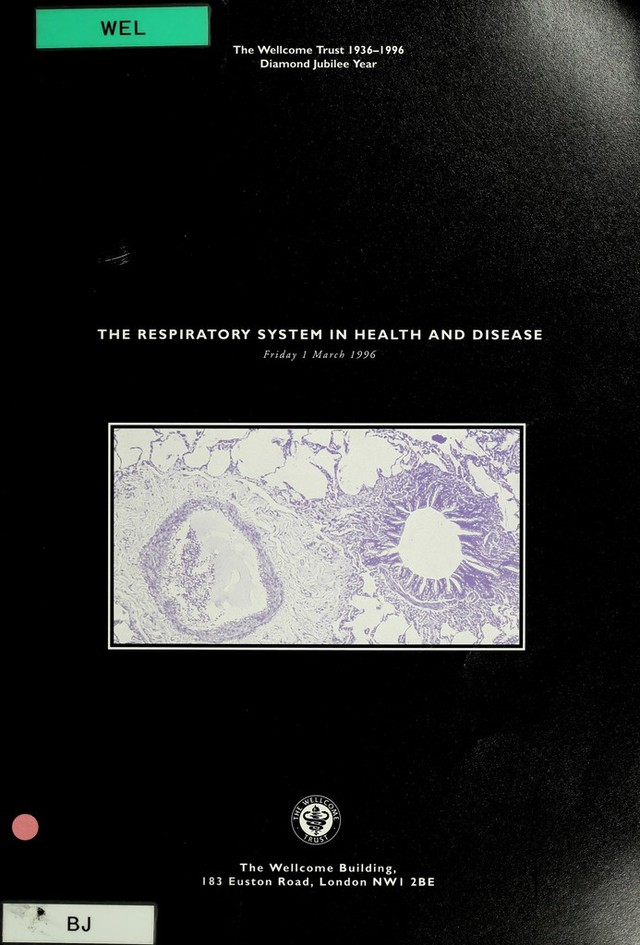
The respiratory system in health and disease : Friday March 1 1996 / The Wellcome Centre for Medical Science.
- Date:
- 1995
Licence: Public Domain Mark
Credit: The respiratory system in health and disease : Friday March 1 1996 / The Wellcome Centre for Medical Science. Source: Wellcome Collection.
27/140 page 19
![DEVELOPMENTAL CHANGES IN OXYGEN SENSITIVITY OF CATECHOLAMINE SECRETING CELLS Mart H Mojet, Elliott Mills, Mark Hanson and Michael R Duchen Dept of Physiology, University College London, Gower Street, London. WCJE6BT Adrenal chromaffin cells and the oxygen sensing Type I cells of the carotid body are ontogenetically closely related. As such, both secrete catecholamines in response to a decrease in oxygen partial pressure (PO2). In addition, the sensitivity of each system changes within the first two weeks of life: where the sensitivity of the carotid body to hypoxia increases, the responsiveness of the adrenal medulla decreases. We have addressed the cellular processes underlying these responses and their modification during development. Using isolated cells, we have employed microfluorimetric and fluorescence imaging techniques to examine changes in mitochondrial function and intracelular free calcium ([Ca2*];), the amphotericin perforated patch clamp technique to study changes in membrane current or membrane potential, and amperometry at carbon fibre microelectrodes to study catecholamine secretion. Using the latter technique, the secretion of individual catecholamine containing vesicles was resolved. As some of these techniques can be applied simultaneously, we have also been able to assess quantitative and temporal relationships between these variables. Systematic examination of the specific oxygen sensitivity of the rat adrenal chromaffin cells revealed that in newborn rats severe hypoxia induces a depolarisation of mitochondrial potential, an increase in NADH/NAD* ratio, a rise in [Ca**]; and an increase in catecholamine secretion. Thus, the secretion of catecholamines from the adrenal during neonatal asphyxia is exocytotic in nature and reflects an intrinsic response property of the chromaffin cells. An equivalent set of responses is seen to cyanide, a specific inhibitor of mitochondrial respiration. This correlation suggests that hypoxia is sensed in the mitochondria. The increase in ([Ca2*];) stems from Ca* influx through plasma membrane channels, as it is blocked by D-600 and requires the presence of external Ca2*. We are currently attempting to identify the mechanisms that couple inhibition of mitochondrial respiration 2+ to an increase in Ca influx. In the neonatal period, asphyxia-induced catecholamine secretion plays a role in prolonging survival and is also thought to affect lung compliance, resorption of lung fluid and production of surfactant, processes critical in establishing neonatal respiratory competence.-Indeed, in animals at 2-4 weeks of age, cyanide still causes the expected changes in mitochondrial potential and redox state, but the changes in ([Ca2*]; and secretion are substantially reduced. Currently we are also examining the response properties of Type I cells of the sheep carotid body, as the developmental changes in this species have been well defined. Changes in sensitivity occur after birth, in order to maintain chemoreflexes in the face of the large rise in arterial PO2, postnatally. However, very little is known of the properties of Type I cells of the sheep. Preliminary studies show that the cells respond to depolarisation and inhibition of mitochondrial respiration with changes in ([Ca *]i similar to the changes obtained in the newborn rat adrenal chromaffin cells. We are currently attempting to correlate changes in mitochondrial potential, ([Ca2*];) and secretion with hypoxia, to compare the O2 sensitivities between foetal and two week old animals.](https://iiif.wellcomecollection.org/image/b20456682_0027.jp2/full/800%2C/0/default.jpg)