A manual of bandaging : adapted for self-instruction / by C. Henri Leonard.
- Leonard, C. Henri (Charles Henri), 1850-1925
- Date:
- [1876?]
Licence: Public Domain Mark
Credit: A manual of bandaging : adapted for self-instruction / by C. Henri Leonard. Source: Wellcome Collection.
Provider: This material has been provided by the Francis A. Countway Library of Medicine, through the Medical Heritage Library. The original may be consulted at the Francis A. Countway Library of Medicine, Harvard Medical School.
134/172 (page 128)
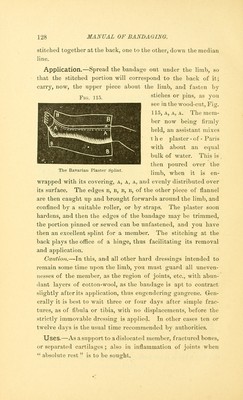
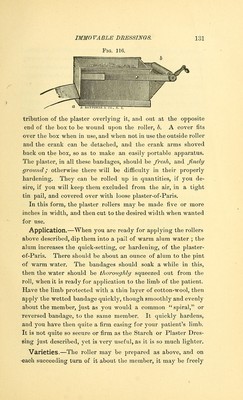
![stitched together at the back, one to the other, down the median Fig. ]15. The Bavarian Plaster Splint. Application.—Spread the bandage out under the limb, bo that the stitched portion will correspond to the back of it; carry, now, the upper piece about the limb, and fasten by stiches or pins, as you see in the wood-cut, Fig. 115, a, a, a. The mem- ber now being firmly held, an assistant mixes the plaster - of - Paris with about an equal bulk of water. This is then poured over the limb, when it is en- wrapped with its covering, A, A, a, and evenly distributed over its surface. The edges b, b, b, b, of the other piece of flannel are then caught up and brought forwards around the limb, and confined by a suitable roller, or by straps. The plaster soon hardens, and then the edges of the bandage may be trimmed, the portion pinned or sewed can be unfastened, and you have then an excellent splint for a member. The stitching at the back plays the office of a hinge, thus facilitating its removal and application. Caution.—In this, and all other hard dressings intended to remain some time upon the limb, you must guard all uneven- nesses of the member, as the region of joints, etc., with abun- dant layers of cotton-wool, as the bandage is apt to contract slightly after its application, thus engendering gangrene. Gen- erally it is best to wait three or four days after simple frac- tures, as of fibula or tibia, with no displacements, before the strictly immovable dressing is applied. In other cases ten or twelve days is the usual time recommended by authorities. Uses.—As a support to a dislocated member, fractured bones, or separated cartilages; also in inflammation of joints when absolute rest is to be sought.](https://iiif.wellcomecollection.org/image/b21064064_0134.jp2/full/800%2C/0/default.jpg)