A manual of bandaging : adapted for self-instruction / by C. Henri Leonard.
- Leonard, C. Henri (Charles Henri), 1850-1925
- Date:
- [1876?]
Licence: Public Domain Mark
Credit: A manual of bandaging : adapted for self-instruction / by C. Henri Leonard. Source: Wellcome Collection.
Provider: This material has been provided by the Francis A. Countway Library of Medicine, through the Medical Heritage Library. The original may be consulted at the Francis A. Countway Library of Medicine, Harvard Medical School.
160/172 (page 154)
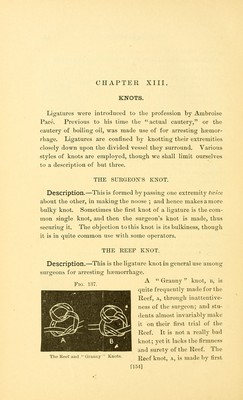
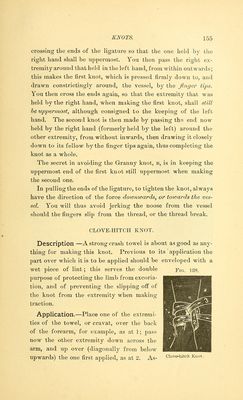
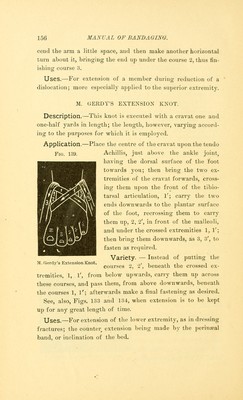
![CHAPTER XIII. KNOTS. Ligatures were introduced to the profession by Ambroise Pare. Previous to bis time tbe actual cautery, or the cautery of boiling oil, was made use of for arresting haemor- rhage. Ligatures are confined by knotting their extremities closely down upon the divided vessel they surround. Various styles of knots are employed, though we shall limit ourselves to a description of but three. THE SURGEON'S KNOT. Description.—This is formed by passing one extremity twice about the other, in making the noose ; and hence makes a more bulky knot. Sometimes the first knot of a ligature is the com- mon single knot, and then the surgeon's knot is made, thus securing it. The objection to this knot is its bulkiness, though it is in quite common use with some operators. THE REEF KNOT. Description.—This is the ligature knot in general use among surgeons for arresting haemorrhage. A Granny knot, b, is quite frequently made for the Reef, a, through inattentive- ness of the surgeon; and stu- dents almost invariably make it on their first trial of the Reef. It is not a really bad knot; yet it lacks the firmness and surety of the Reef. The Reef knot, a, is made by first T154] Fig. 133 The Reef and . Granny Knots.](https://iiif.wellcomecollection.org/image/b21064064_0160.jp2/full/800%2C/0/default.jpg)