A manual of bandaging : adapted for self-instruction / by C. Henri Leonard.
- Leonard, C. Henri (Charles Henri), 1850-1925
- Date:
- [1876?]
Licence: Public Domain Mark
Credit: A manual of bandaging : adapted for self-instruction / by C. Henri Leonard. Source: Wellcome Collection.
Provider: This material has been provided by the Francis A. Countway Library of Medicine, through the Medical Heritage Library. The original may be consulted at the Francis A. Countway Library of Medicine, Harvard Medical School.
27/172 (page 21)
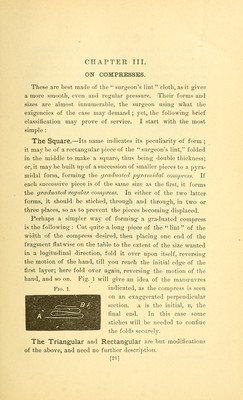
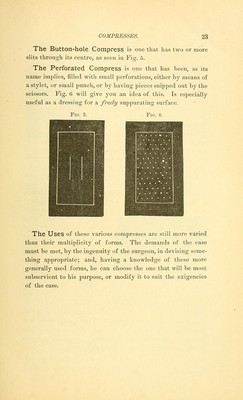
![ON COMPBESSES. These are best made of the surgeon's lint cloth, as it gives a more smooth, even and regular pressure. Their forms and sizes are almost innumerable, the surgeon using what the exigencies of the case may demand ; yet, the following brief classification may prove of service. I start with the most simple : The Square.—Its name indicates its peculiarity of form ; it may be of a rectangular piece of the surgeon's lint, folded in the middle to make a square, thus being double thickness; or, it may be built up of a succession of smaller pieces to a pyra- midal form, forming the graduated pyramidal compress. If each successive piece is of the same size as the first, it forms the graduated regular compress. In either of the two latter forms, it should be stiched, through and through, in two or three places, so as to prevent the pieces becoming displaced. Perhaps a simpler way of forming a graduated compress is the following : Cut quite a long piece of the lint of the width of the compress desired, then placing one end of the fragment flatwise on the table to the extent of the size wanted in a logitudinal direction, fold it over upon itself, reversing the motion of the hand, till you reach the initial edge of the first layer; here fold over again, reversing the motion of the hand, and so on. Fig. 1 will give an idea of the manoeuvres Fig. 1. indicated, as the compress is seen on an exaggerated perpendicular section, a is the initial, b, the final end. In this case some stiches will be needed to confine the folds securely. The Triangular and Rectangular are but modifications of the above, and need no further description. [21]](https://iiif.wellcomecollection.org/image/b21064064_0027.jp2/full/800%2C/0/default.jpg)