Registration of the causes of death : circulars to medical practioners, and to registrars, a statistical nosology, for the use of those who return the causes of death under 6 and 7 Will. IV., c. 86, circular to coroners, and a classification of the causes of violent deaths.
- General Register Office Northern Ireland
- Date:
- 1845
Licence: Public Domain Mark
Credit: Registration of the causes of death : circulars to medical practioners, and to registrars, a statistical nosology, for the use of those who return the causes of death under 6 and 7 Will. IV., c. 86, circular to coroners, and a classification of the causes of violent deaths. Source: Wellcome Collection.
Provider: This material has been provided by The Royal College of Surgeons of England. The original may be consulted at The Royal College of Surgeons of England.
12/84 page 10
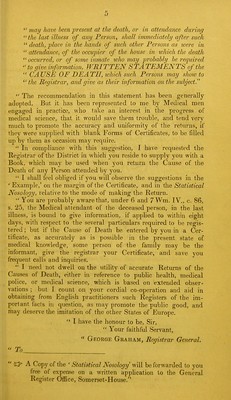
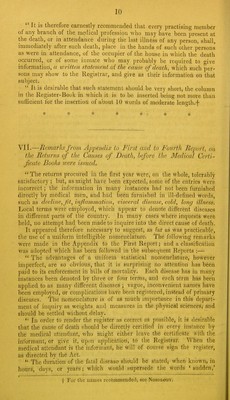
![It is therefore earnestly rcommencled that every practising member of any branch of the medical profession who may have been present at the death, or in attendance during the last illness of any person, shall, immediately after such death, place in the hands of such other persons as were in attendance, of the occupier of the house in which the death occurred, or of some inmate who may probably be required to give information, a written statement of the cause of death, which such per- sons may show to the Registrar, and give as their information on that subject. It is desirable that such statement should be very short, the column in the Register-Book in which it is to be inserted being not more than sufficient for the insertion of about 10 vVords of moderate length.f * * * * *• * * VI1.—Remarks from A])pendix to First mid to Fourth Report, on the Returns of the Causes of Death, before the Medical Certi- ficate Boohs were issued. The returns procured in the first year were, on the whole, tolerably satisfactory ; but, as might have been expected, some of the entries were incorrect; the information in many instances had not been furnished directly by medical men, and had been furnished in ill-defined words, such as decline, Jit, inflammation, visceral disease, cold, long illness. Local terms were employed, which appear to denote diiferent diseases in different parts of the country. In many cases where inquests were held, no attempt had been made to inquire into the direct cause of death. It appeared therefore necessary to suggest, as far as was practicable, the use of a uniform intelligible nomenclature. The following remarks ■were made in the Appendix to the First Report; and a classification vras adopted which has been followed in the subsequent Reports :— The advantages of a uniform statistical nomenclature, however imperfect, are so obvious, that it is surprising no attention has been paid to its enforcement in bills of mortality. Each disease has in many instances been denoted by three or four terms, and each term has been applied to as many different diseases ; vague, inconvenient names have been employed, or complications have been registered, instead of primary diseases. The nomenclature is of as much importance in this depart- ment of inquiry as weights, and measures in the physical sciences,- and should be settled without delay. *' In order to render the register as correct as possible, it is desirable that the cause of death should be directly certified in every instance by the medical attendant, who might either leave the certificate .vith the informant, or give it, upon application, to the Registrar. When the medical attendant is the informant, he will of course sign the register, as directed by the Act. ■ The duration of the fatal disease should be stated, when known, in hours, days, or years; which would supersede the words 'sudden,' f For the names rec6jninended, see Nosoijotn-.](https://iiif.wellcomecollection.org/image/b22270267_0012.jp2/full/800%2C/0/default.jpg)

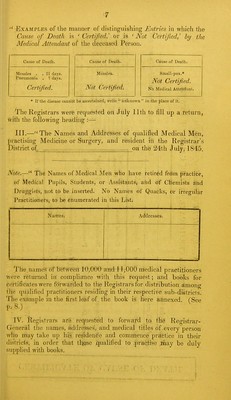
 No text description is available for this image
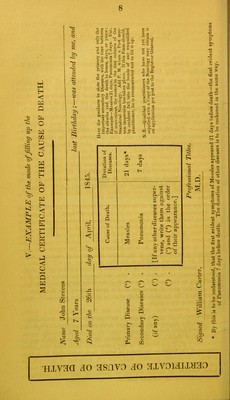
 No text description is available for this image
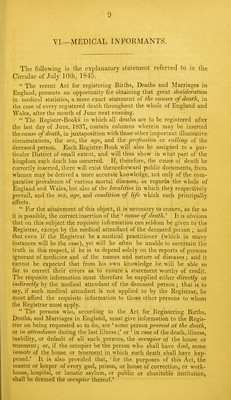
 No text description is available for this image