Registration of the causes of death : circulars to medical practioners, and to registrars, a statistical nosology, for the use of those who return the causes of death under 6 and 7 Will. IV., c. 86, circular to coroners, and a classification of the causes of violent deaths.
- General Register Office Northern Ireland
- Date:
- 1845
Licence: Public Domain Mark
Credit: Registration of the causes of death : circulars to medical practioners, and to registrars, a statistical nosology, for the use of those who return the causes of death under 6 and 7 Will. IV., c. 86, circular to coroners, and a classification of the causes of violent deaths. Source: Wellcome Collection.
Provider: This material has been provided by The Royal College of Surgeons of England. The original may be consulted at The Royal College of Surgeons of England.
74/84 page 72
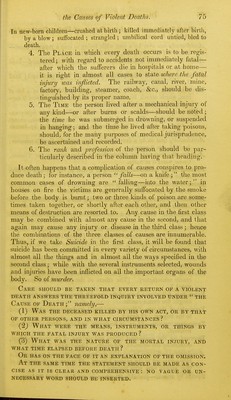
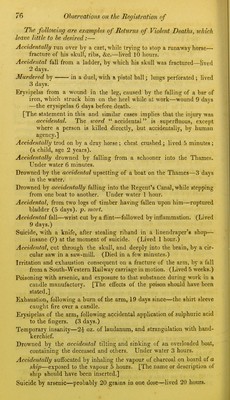
![Miscellaneous machinery^ or such as is used not in actual manufac- turing, but in auxiliary processes, such as teagles, cranes, hoists, grindstones. Also mercury, lead, acids, alkalis, and other chemical agents, which are causes of death in manufactories, &c. [The name of the work, or of the owner of the work, factory, or machine, should always be stated, as in the following instance: — Laceration of the scalp by a carding machine in John Holt's factory—lived 9 days; erysipelas, 5 days.] Mines and Coal-pits—State the department the deceased was engaged in, under *' rank or profession —distinguishing the viewer, overman, back-overman, hewer, putter, trapper, *' crane-boy, rolley-driver, roUey-way-raan, Davy lamp- keeper, furnace-man, stable-keeper, wasteman, shifter, ousetter, banksman, brakesman, &c. Falls—1\\ shaft, stapple, drift, or water-level, waste, rolley-way, tram-way, goaf, workings—men falling through rope having been cut or broke when riding away (de- scending, &c.,) or breaking of pit chain, or slipping of knot, —fall down coal-pit shaft, or stapple, &c. Falls—of stone or coal; of roof of mine; of coal-pit tub; corfe, kibble, prop, pick, hammer, &c. Blows—when driving in dark or light, by crane-handle, rolley, tram, blasting stone or coal, hewing, drawing a jud, blows of capstan, of swingle-tree, of gin or winsey, pit machinery, stamp mills, or steam-engine, &c. ? Explosion—State whether killed by the direct effect of fire, or from suffocation by the after-damp, choke damp, or styth— either immediately after the accident, or at a later period in ren- dering assistance, &c. State where the explosion happened, in the waste, face of workings, or goaf, &c.—whether Davy lamps, raw lights, or flint mills, were in use when the explosion happened—whether the mine had one shaft or more. In explosions fatal to many lives, note the diameter of the shaft and the acres of royalty; and whether the ventilation was conducted by a furnace or lamp, the method simple, scaling, or com- pound; whether the mine was working in the whole, or the broken. The name of the mine, and the owners' names should be always recorded. Droioning—in mines—where was the water from ? What caused the accident ? Was the shaft to the rise or the dip of the coal field or seam Did the seam keep a water engine, and of what power was that engine ? Quarries:— Roof of a quarry falling in, stone falling in, fell into a quarry. Fall of heavy substances :—Fall of stones, of limestone, a piece of marble, marl, sand ; brick wall, part of a new chapel, a theatre, abridge, an arch; apiece of timber, wood, a pile of deals,'^ a beam ; a box of soap, a bale of cotton, a box of sugar; a mallet a crane, a rope, a boat, a piece of iron.](https://iiif.wellcomecollection.org/image/b22270267_0074.jp2/full/800%2C/0/default.jpg)
 No text description is available for this image
 No text description is available for this image
 No text description is available for this image