Report to the House of representatives of the United States of America : vindicating the rights of Charles T. Jackson to the discovery of the anaesthetic effects of ether vapor, and disproving the claims of W.T.G. Morton to that discovery. Presented ... on the 28th of August, 1852 / By Hon. Edward Stanly ... and Hon. Alexander Evans ... members of the select committee on the ether discovery. Printed by authority of the minority of the committee.
- Edward Stanly
- Date:
- [1852?]
Licence: Public Domain Mark
Credit: Report to the House of representatives of the United States of America : vindicating the rights of Charles T. Jackson to the discovery of the anaesthetic effects of ether vapor, and disproving the claims of W.T.G. Morton to that discovery. Presented ... on the 28th of August, 1852 / By Hon. Edward Stanly ... and Hon. Alexander Evans ... members of the select committee on the ether discovery. Printed by authority of the minority of the committee. Source: Wellcome Collection.
Provider: This material has been provided by the Harvey Cushing/John Hay Whitney Medical Library at Yale University, through the Medical Heritage Library. The original may be consulted at the Harvey Cushing/John Hay Whitney Medical Library at Yale University.
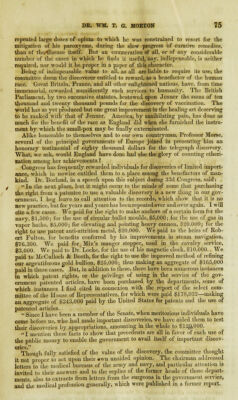
![Surgeon General's Office, Washington City, I>. C, February 2-t, 1883. Sir.: I bave (he honor to acknowledge the receipt of your communication of this date, asking my vi.-ws relative to compensation to be paid Dr. W. T. G.Morton for the advan- t.iigci' whioli ih.' Government has received from the use of antesthetics in the army and i .v\. and for the benefits which will in future be derived from it. 1 11nnU there would be manifest propriety in giving Dr. Morton a substantial reward ftw lire gredt discovery made by him—a discovery which has been of incalculable benefit i.o the sick and wounded of the army and navy. It may be safely asserted that in 99 pes oettt. of Hie operations performed in our military hospitals and on the field of battle niiieslhetu'S are u*ed. I am clearly of the opinion that the sum of two hundred thousand dollars would be little eiioujl] to bestow on Dr. Morton for the advantages which have accrued and will accrue in future to the Government through the use of the means, which he was the first to discover, ol niluviating human suffering. It gives me great pleasure to state that immedi- ately after the battle of Fredericksburg, Dr. Morton administered ether several times, at Falmouth, with the greatest skill and efficiency to patients upon whom I was operating. I am, sir, very respectfully, your obedient servant, W. A. HAMMOND, Surgeon General. Hon. Henrv Wilson, Chairman Military Committee, U. S. Senate, Washington, D. C. Navy Department, Bureau of Medicine and Surgery, February 2, 1863. Sir: I have tlip honor to acknowledge the receipt of your communication of the 29fh ultimo, inquiring whether or not anesthetics are generally used in the surgical operations performed by the surgeons in the service of this government. • •«••** ##• I beg leave to state, in reply, that anaesthetics have come into such general use that a surgical operation performed without such agents may be regarded as the exception to an almost universal rule in this as in other countries. # # • • * • • # # • In tin' Crimea alone, according to the calculations of Mr. Scrive, it was admini.-tcred to more than twenty thousand wounded. Very respectfully, your obedient servant, W. WHELAN. Hon. IIf.msy 'Wilson, Chairman Committee on Military Affairs, U. S. Senate. Surgeon General's Office, March 1, 1852. Sir: In compliance with your verbal request to be furnisjied with informa- tion in regard to the employment of anaesthetic agents in the army of the United States, and also for an expression of opinion as to the value and importance of this class of remedial agents, I have to state: That sulphuric ether and chloroform were used to some extent in the military hospitals established at the theatre of war in Mexico, but the use of those articles was not so geueral as at present, for the reason that the apparatus at that time believed to be essential to their proper and safe administration was not adapted to service in the field. At the present moment it is believed that no surgical operation of importance is performed by the medical officers of the army without the aid of some anaes- thetic agent. Previous to the discovery of this new application of sulphuric ether, the an- nual supply of that medicine was one pound for every hundred men. On the revision of the standard supply table, by a board of medical officers in 1840, the pure washed sulphuric ether was substituted for the ordinary sulphuric ether, and the quantity allowed was increased one hundred per cent. At the same time another anaesthetic agent, the tincture of chloroform, commonly called chloric ether, was added to the supply table, and is now regularly furnished to the med- ical officers in such quantities as, in connexion with the sulphuric ether, will suffice to meet all the demands of the service in this particular. Although the discovery of this new therapeutic effect of sulphuric ether has led to the introduction and employment of other anaesthetic agents, this does not](https://iiif.wellcomecollection.org/image/b21002551_0146.jp2/full/800%2C/0/default.jpg)