What to observe at the bed-side and after death in medical cases.
- London Medical Society of Observation
- Date:
- 1853
Licence: Public Domain Mark
Credit: What to observe at the bed-side and after death in medical cases. Source: Wellcome Collection.
Provider: This material has been provided by The Royal College of Surgeons of England. The original may be consulted at The Royal College of Surgeons of England.
25/166 (page 1)
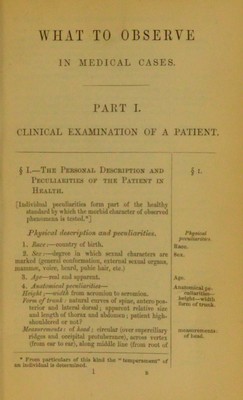
![WHAT TO OBSERVE IN MEDICAL CASES. TAUT I. CLINICAL EXAMINATION OF A PATIENT. § I.—The Personal Description and § i. Peculiarities of the Patient in Health. [Individual peculiarities form j)art of the healthy | staudanl by which the morbid character of observed j phenumeua is tciited.*] Physical description and peculiarities. 1. Bace.—country of birth. 2. Sex:—degree in which sexual characters are marked (generul eunformation, external sexual organs, maiumw, voice, beard, pubic hair, etc.) 3. jtye—real and apparent. 4. Amatomical peculiarities— Height;—width from acromion to acromion. Form of trunk: natural curves of spine, antcro pos- terior and lateral dorsal; apparent relative size and length of thorax and abdomen; patient high- shouldcnvl or not? Measurements: oi head; circular (over snperciliarv ridges and occipital protuberance), across vertex (from ear to car), along middle line (from root of Pkftical pccutmritwi Race. Sex. -Age. ' Anatomical pe* I -..ii--‘tlsn I height—width form of trunk. measurtments: of head. • From particular* of this kind the “ temt^ramenf of an individual is determined.](https://iiif.wellcomecollection.org/image/b22267748_0027.jp2/full/800%2C/0/default.jpg)