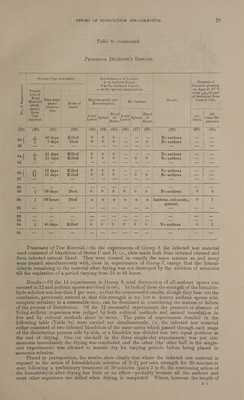
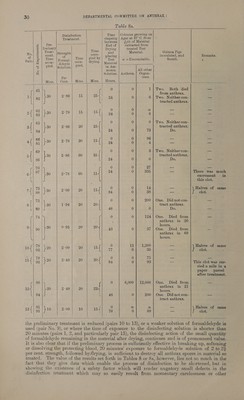
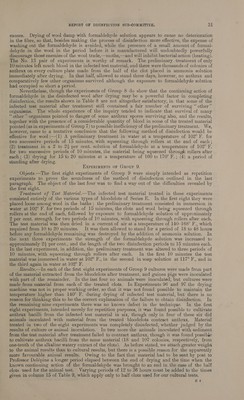
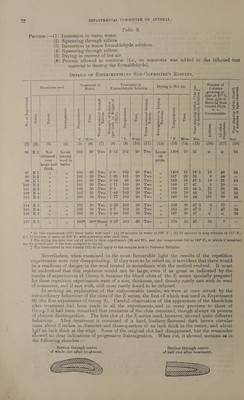
Report of the Departmental Committee apointed to inquire as to precautions for preventing danger of infection from anthrax in the manipulation of wool, goat hair, and camel hair.
- Great Britain. Committee on Anthrax.
- Date:
- 1918
Licence: Public Domain Mark
Credit: Report of the Departmental Committee apointed to inquire as to precautions for preventing danger of infection from anthrax in the manipulation of wool, goat hair, and camel hair. Source: Wellcome Collection.
37/356 page 29
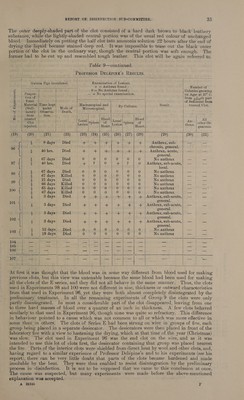
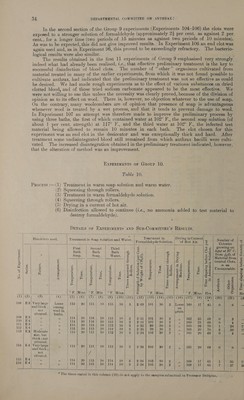
![Table 8—continued. Proressor DELEPINE’S RESULTS. Guinea Pigs inoculated, Examination of Lesions. | | + == Anthrax found ; Number of u 0=No Anthrax found ; Colonies growing oi, | — = No special examination. | | on Agar at 37° C. 5 | oe | | Bee ee BS ay, Cee eS Rees from zoooth part es | rie 1 Time kept. Macroscopical and BS Cultur | Result. Rene oa re | under Mode of Microscopical. Sats sete | 3 | @ect- | Observa- Death, SSE 4d ERA o) ment) tion. | l j | | : 4 | from Ea | Blood! Blood All é ee . | Local ‘spleen! of (Local lepteen of ame other Or- i Na . “3 | Heart. ““* asses aes ganisms (9) (20), (21), (22) ~—~*|: @3)| @H) @5)) 6) | 27) GS) (29) (80) | (81) | | | | | | | got ag | 40 days Killed 0 0; 0}; —}| =] — No anthrax tiie ip { ere > | Pidays | Died 0 0 0 —;| —| 0 No anthrax ae a4 83 —_— | — = ae ee TH ance 1 Ieee men fe —— — —- . eB raisin Seem EUR didi, i 2 oes Ss 8A. | go (4i days’ Killed 0) 07 7.8 —}| —; —| No anthrax = = { | + £| 11 days) Killed 0 Or Ts ¢ — | 0 0 No anthrax = = a Sh 4 = — | — — —_—- — = se = —— — =~ | coke | as SO les irs SL fel ae em Se Oe a ee 86 ao 37 days _ Killed @ <0.) 0 } —{| —| — No anthrax , = — 14 ll days Killed 0 0 0 _ 0 No anthrax ; — 87 — o —— i ch least el eieoos ml |oe raels William 4 (eee ee ie = =a get, a eee a ie a ge 89 + 38 days Died 0 0 0 0 0} 0 No anthrax 0 0 90 4 69 hours Died + + + + + + | Anthrax, sub-acute, 0 1 | general. 91 aa —_ —_ —f —} —} —] eye ~ — —_ ro ead 0 I cae SES BEE a | Sas ee a ee ee ee aa 93 — — = c= yA tgs (lt sy 0 Reson Sah all Dae — atts cat Se Diee 94 | + |48days | Killed Ge 07 pee Ok Oye OL aoc: Nolanthrax) |} 0s.) 4 as ee Se ee aT oe | = pa ag Treatment of Test Material.—In the experiments of Group 8 the infected test material used consisted of bloodeclots of Series C and D, 2.e., clots made both from infected citrated and from infected natural blood. They were treated in exactly the same manner as, and many were treated simultaneously with, clots in experiments of Group 7, except that the formal- dehyde remaining in the material after drying was not destroyed by the addition of ammonia till the expiration of a period varying from 24 to 84 hours. Results.—Of the 14 experiments in Group 8, total destruction of all anthrax spores was secured in 12 and anthrax spores survived intwo. In both of these the strength of the formalde- hyde solution was less than 1 per cent., so that the unsuccessful results, though they bear out the conclusion, previously arrived at, that this strength 1s too low to destroy anthrax spores with complete certainty in a reasonable time, can be dismissed in considering the success or failure of the process of disinfection. Of the 12 successful experiments, the presence or absence of living anthrax organisms was judged by both cultural methods and animal inoculation in five and by cultural methods alone in seven. The pairs of experiments detailed in the following table (‘Table 84) were carried out simultaneously, 7e., the infected test material either consisted of two infected bloodclots of the same series which passed through each stage of the disinfection process side by side, or a bloodclot was divided into two equal portions at the end of drying. One (or one-half in the three single-clot experiments) was put into ammonia immediately the drying was concluded, and the other (the other half in the single- clot experiments) was allowed to remain dry for varying periods before being placed in ammonia solution. . | Placed in juxtaposition, the results show clearly that where the infected test material is exposed to the action of formaldehyde solution of 2-25 per cent. strength for 20 minutes or over, following a preliminary treatment of 30 minutes (pairs 3 to 8), the continuing action of the formaldehyde after drying has little or no effect—probably because all the anthrax and most other organisms are killed when drying is completed. Where, however, the length of E 3](https://iiif.wellcomecollection.org/image/b32178049_0037.jp2/full/800%2C/0/default.jpg)