Report of the Departmental Committee apointed to inquire as to precautions for preventing danger of infection from anthrax in the manipulation of wool, goat hair, and camel hair.
- Great Britain. Committee on Anthrax.
- Date:
- 1918
Licence: Public Domain Mark
Credit: Report of the Departmental Committee apointed to inquire as to precautions for preventing danger of infection from anthrax in the manipulation of wool, goat hair, and camel hair. Source: Wellcome Collection.
40/356 page 32
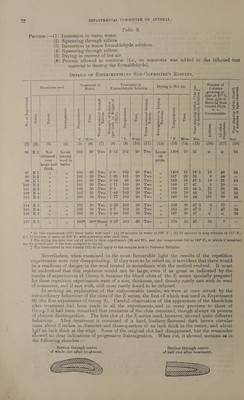
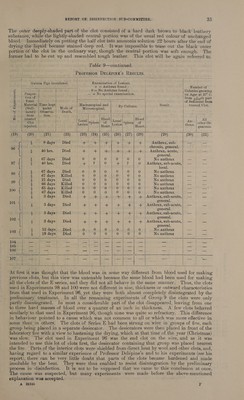
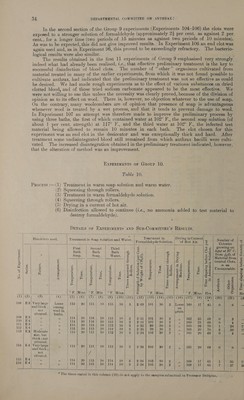
![c Table 9. Peroorss :-—(1) Immersion in warm water. (2) Squeezing through rollers. (3) Immersion in warm formaldehyde solution. (4) Squeezing through rollers. é (5) Drying in current of hot air. (6) Process allowed to continue (ze. no ammonia was added to the infected test material to destroy the formaldehyde). Deratts of ExpertMENtsiND Sosp-OommMitrec's REsuUts. | Treatment i Treatment in Peau As shy Number of Bloodclots used. asker. = Formaldehyde Solution. Drying in HovAir, Bas Colonies a3 2e¢ growing on EP ; i 6.8 | Agar at 37°C.| £3 a rs om r| op O | from +)th of - 3 2 a as a 2% | Material from | & & a S |-34 5 5 a treated Clots. | % 58 ® 3 : q 6 5 | A oe | 3< 2, z 2 2 |a3 H 3 z a's oS | oe A : 5 5 aw RE S 3 amWwnm a=! o 2 : ag © U t; bl op A ica] n © g ae) ef OH S ne a © 2 A = a a g ncountaple. | ° oa fo =} o S Serra sac H aI Nv ea By f=) aE aes ‘S a0 g Or Gio ® | o > o a rms) x 8 3 a Ss. Pa oo |g O | «6 a LS a 3 2 = Aud ae 7 fs} = a Sy. on o 5 So o oO M “a q s a eae Bt SOU Ee g | & fl F EB udaal x A las is We > z ed a eS 5 & a < a ee | fe ERE Sl : F. Mins. | ¥ ¥, Mins, : F. Mins. Hys. -) Hrs. @d)@) 3) | 4& | &) |) @M] @)ob () | G0)] Ca) 2) 7 48) | (14) |e(te) |} 6s (tz) (18) 96 13! Not | Loose | 102] 30 | two! 2:12 | 102 | 20 | Two| Loose | 140+ 10/22 | o | ow | 24 citrated ; among on very | wool in grids large and baths. thick. 97 |B1|° %, » | 102} 30) Two] 2-0 | 102] 20|/Twol ,, | 1404 15 [ 18-5; 10 | 49 | 94 98 |\E38 a 102 |} 30 | Two} 1°95 | 101 | 20 | Two N 167 | 20) 18 0 44 _ 99 |E3 - < 101 | 30 | Two} 2°18; 98 20 | Two 26 163.) 18 | 47-5 18 31 24 100 |H 2 = 101 | 30 (Two )-2:11>| 100 1) 20s iws i 168 | .17 | 47 0 10 — 101 |K 2 - ay 102 | 30. 1,Two.|-2°0 9) 1025) 205 iwe P. 168.| , 19.) 44-5.) 21 36 24 102 |B 4 + so LOZ 80 I Bwore Soa. £02 tea we “5 168 | 19 | 44 18 16 24 103 |B 3} i 2 100 | 380 | Two) 1°77 | 102 20 | Two i 168 | 19 | 44 107 39 24 [ee a eae a SEL Prien, kame eae EM es e 104 |E3 =. » | 102 | 30 | Two} 2-39. | 102 30 | Two - 168 20 | 47°5 0 77 = 105 | EB 4! 39 Ms 102 | 30 | Two} 2:7 102 | 30 | Two zs 165 20 | 47-5 | 47 24 106 |E3) * Hs 102 | 30 | Two | 2°68-; 100 30 | Two # 167 20 | 47 oO oO 24 107 |H3|,, , | 102%) 30*/Phreel 2-67 | 103! 30]}Twol ,, |170| 15| 47 | 32 eee K 4 * In this experiment (107) three baths were used: (@) 10 minutes in water at 102° F.; (6) 10 minutes in soap solution at 117° F.; (c) 10 minutes in water at 102° F., with squeezing after each bath. ; + The drying machine was out of order in these experiments (96 and 97), and the temperature fell to 140° F., at which it remained for the greater part of the time occupied in drying. + The times stated in this column (15) do not apply to the samples sent to Professor Delépine. Nevertheless, when examined in the most favourable light the results of the repetition experiments were very disappointing. If they were to be relied on, it is evident that there would be a residuum of danger in the wool treated in accordance with the method evolved. It must be understood that this residuum would not be large, even if as great as indicated by the results of experiments of Group 9, because the blood clots of the E series specially prepared for these repetition experiments were of a size, thickness, and density rarely met with in wool of commerce, and if met with, still more rarely found to be infected. . In seeking an explanation of the unfavourable results, we were at once struck by the extraordinary behaviour of the clots of the E series, the first of which was used in Experiment 96 (the first experiment of Group 9). Careful observation of the appearance of the bloodclots after treatment had been made in all the experiments, and in many previous to those of Group 9 it had been remarked that remnants of the clots remained, though always in process of obvious disintegration. The first clot of the E series used, however, showed quite different behaviour. After treatment it. consisted of a hard, leathery flattened dark brown circular mass about 2 inches in diameter and three-quarters of an inch thick in the centre, and about](https://iiif.wellcomecollection.org/image/b32178049_0040.jp2/full/800%2C/0/default.jpg)