Report of the Departmental Committee apointed to inquire as to precautions for preventing danger of infection from anthrax in the manipulation of wool, goat hair, and camel hair.
- Great Britain. Committee on Anthrax.
- Date:
- 1918
Licence: Public Domain Mark
Credit: Report of the Departmental Committee apointed to inquire as to precautions for preventing danger of infection from anthrax in the manipulation of wool, goat hair, and camel hair. Source: Wellcome Collection.
43/356 page 35
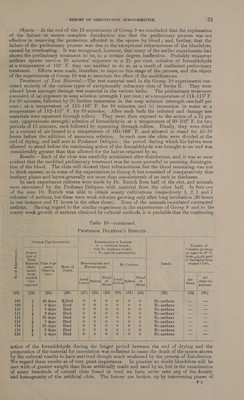
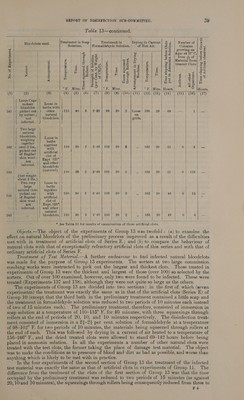
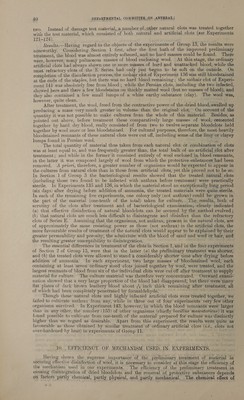
![Objects. - At the end of the 12 experiments of Group 9 we concluded that the explanation -of the failure to secure complete disinfection was that the preliminary process was not effective in removing the protection afforded to the spores by blood; and, further, that the failure of the preliminary process was due to the exceptional refractoriness of the bloodclots, caused by overheating. It was recognised, however, that many of the earlier experiments had shown the preliminary treatment to be, in a certain degree, ineffective. Probably whenever anthrax spores survive 20 minutes’ exposure to a 23 per cent. solution of formaldehyde at a temperature of 102° F. they are enabled to do so as a result of inefficient preliminary ‘treatment. Efforts were made, therefore, to improve this stage of the process, and the object of the experiments of Group 10 was to ascertain the effect of the modifications. Treatment of Test Material.—The test material used in the Group 10 experiments con- sisted entirely of the various types of exceptionally refractory clots of Series KE. They were placed loose amongst damage test material in the various baths. The preliminary treatment consisted of (a) exposure to soap solution (strength 1 per cent.) at a temperature of 114-115° F. for 20 minutes, followed by (6) further immersion in the soap solution (strength one-half per cent.) ata temperature of 115-116° F. for 10 minutes, and (c) immersion in water at a temperature of 112-115° F. for 10 minutes. After each bath the infected and damage test materials were squeezed through rollers. They were then exposed to the action of a 34 per cent. (approximate strength) solution of formaldehyde at a temperature of 99-102° F. for two periods of 15 minutes, each followed by squeezing through rollers. Finally, they were dried in a current of air heated to a temperature of 160—-168° F. and allowed to stand for 45-70 hours before the addition of ammonia solution. In each case the clots were divided at the end of drying, and half sent to Professor Delépine; the period during which his halves were allowed to stand before the continuing action of the formaldehyde was brought to an end was considerably greater than that allowed for the halves retained by us. Results. — Each of the clots was carefully scrutinised after disinfection, and it was at once evident that the modified preliminary treatment was far more powerful in securing disintegra- tion of the blood. The clots still showed their refractoriness, but the blood remaining was not in thick masses, as in some of the experiments in Group 9, but consisted of comparatively thin leathery plates and layers generally not more than one-sixteenth of an inch in thickness. In each experiment cultures were made by Dr. Eurich from half of the clot, and animals were inoculated by the Professor Delépine with material from the other half. a four out of the nine Dr. Eurich was able to obtain scanty cultivations (respectively 1, 2, 1 and 7 ~ colonies) of anthrax, but these were weak colonies growing only after long incubation (30 hours anthrax. Having regard to the similar experience in the experiments of Group 9 and to the scanty weak growth of anthrax obtained by cultural methods, it is probable that the continuing Table 10—continued. Proressor DELEPINE’S RESULTS. Guinea Pigs inoculated. Examination of Lesions a0 + = Anthrax found ; | Number of Sos 0 = No Anthrax found ; | Colonies growing 5 Propor- — = No special examination. on Agar at 37°C. I tion of s from zgg5th part 5 Total |. of Sediment from ey Material Time kept Macroscopical and By Culture. Result. treated Cloth, cs) (Sedi- under Mode of Microscopical. | ment) | Observa- Death. fv RCo RE Pe aN & from tion. Bil | geen im Zi treated 00 ood Clot e oe Spleen] of ae Spleen| of i ve other Or- injected. F Heart. Heart. “| ganisms, | I (23) (24) (25) | (26) (27) | (28) | (29) | (80) | (81) | (82) (33) (34) (35) 108 4 48 days Killed 0 0 0 0 0 | 0 No anthrax —- — 109 + 9days| Died _ 0 0 0 0 CSG No anthrax —— —_ 110 3 9days; Died = 0 0 0 0 0 0 No anthrax |; RT» seme 111 4 9days| Died 0 0 0 0 0 0 No anthrax — | — 112 3 3ldays| Died = 0 0 0 0 0 0 No anthrax tt ees 113 4 9days| Died | 0 0 0 0) 0 0) No anthrax —- — 114 25 days Died 0 0 0 0 0) 0 No anthrax —- — 115 $ 9days| Died 0 0) 0 0 0 0 No anthrax — | => 116 4 2days| Died 0 0 7 0 0 0 | No anthrax — | — | action of the formaldehyde during the longer period between the end of drying and the preparation of the material for inoculation was sufficient to cause the death of the spores shown ‘by the cultural results to have survived though much weakened by the process of disinfection. We regard these results as of very great importance. In practice no doubt bloodclots will be met with of greater weight than those artificially made and used by us, but in the examination of many hundreds of natural clots found in wool we have never seen any of the density and homogeneity of the artificial clots, The former are broken up by intervening pieces of F 2](https://iiif.wellcomecollection.org/image/b32178049_0043.jp2/full/800%2C/0/default.jpg)