Report of the Departmental Committee apointed to inquire as to precautions for preventing danger of infection from anthrax in the manipulation of wool, goat hair, and camel hair.
- Great Britain. Committee on Anthrax.
- Date:
- 1918
Licence: Public Domain Mark
Credit: Report of the Departmental Committee apointed to inquire as to precautions for preventing danger of infection from anthrax in the manipulation of wool, goat hair, and camel hair. Source: Wellcome Collection.
44/356 page 36
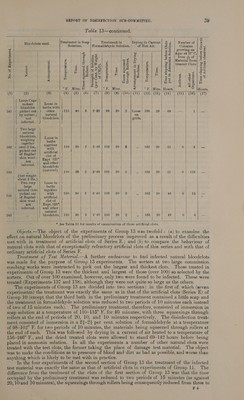
![wool and by fission into many small clots; the latter always consisted of one solid mass of hard dry blood. Further, it is rare to find natural clots infected to anything approaching the degree and uniformity of the artificial clots, if, indeed, they exist at all. Nor have we ever seen natural clots so refractory. Still, the possibility must be taken into account that in hot countries some clots may have been exposed to direct sunlight and may thus have become overheated and hardened to a degree approaching that of the clots of Series E. | At the worst, however, the amount of infection remaining after disinfection would be infinitesimal, and it is beings. The importance, however, of the difference between the results of animal inoculation and of cultivation lies in this—that the progressive action of the formaldehyde whicn has penetrated into and remains in the remnant of blood appears to cause ultimately the death of the few weakened surviving spores. | A is Differences of refractoriness were again observed in clots of the E series used in the Group 10 experiments exactly similar to those noted in experiments of Group 9. The clot used. in Experiment 116 (an end clot again) closely resembled in appearance and behaviour that used in Experiment 96. The superior disintegrating power of the preliminary process in the former experiment was shown by the much greater reduction in size and thickness of the clot as compared with that used in Experiment 96. i EXPERIMENTS OF Group 11. Table 11. Process :—(1) Treatment in warm soap solution. di oe hia of is (2) Squeezing through rollers. 3 e ida ahineod (3) Treatment in warm formaldehyde solution.. i (4) Squeezing through rollers. (5) Drying in a current of hot air. , Bi th) (6) Disinfection allowed to continue (7.e., no ammonia added to test material ' to destroy formaldehyde).. . DETAILS OF EXPERIMENTS AND SuB-CoMMITTEE’S RESULTS. Treatment in Treatment in Time elapsing before Growth of Anthrax on Agar observed Bloodelots used. Soap Solution. Formaldehvaia Relator Drying in-Hot Air. | = Number of bes Eo HE Sa: <A aber) Tee k [ae Colonies | J | | | = = growing on 45.,| a 2 A re | 5-8 | Agar at 87°C, S| | oA ete 2 | from yy = S se S Be . EH | Material from 5 | = S a Ve 3 r ite a) eH Ss | treated Clots. ae ee 3 = te lapel Bo | 2 4) ghee eee = . | aoe o> ond eo = S = ie a S| 8 lok Oa ete g = £g | Uncountable. a = bk S| 8 gee Se eee ee & | 2 | Be eae 7 2 f(A | aS) em) EI sel os Bees = i | =< aS ew | oS ho ra oe 50 a ee: BE | ao ee ae g F 2 | a8 EH | te = 5 ~ oe or (& g ‘geil [Cee . | | 3.) 38 | ° ¥ |Mins.| | = pee. {Mins | | | © BF. Mins. Hours: 4 Oe 8) © 1 ©/M) ® | a ay, a ds) a4 ds) as) ayy ds) 117 |F1)| Very | Loose |110} 30;| 2 | 2-72 | 102 | Socniee Hose on? 168; 20°70 0 1 _— large andjamong wool! | _ grids. : thick;not; in baths. | ! ) . citrated. | | | | 118 F1 “ee 5 110, 30 |..2>'| 2°72°)°102 |, 30] 2 | 39 168 | 20 70 0 4 119 | Fl i — }110' 30 | 2 | 2-62} 102] 20] 2 | » | 158/20| 68 0 1 120 Fl Bay | :: }110' 30 |,.2 | 2°62 | 102 |.20 | 2 d 158 | 20 68 0 1} — 121 | Fl » | Loose {110} 30) 2°) 2°49) 102 |}207 2 | * 162 | 20 | 51 0 4 among | j./ ‘ large | / natural Persian . bioodclots | in baths.* | | bh 122 |F1 : ‘i (110; 30 | 2 | 2:49] 102 | 20) 2 | 3 162 | 20. 51 0 2 123 F2 a /110; 30 | 2 | 2:40) 1083/20] 2 | ,, 163 | 20 | 48 0) Fp 124 |F2) se» {110} 30} 2 | 2°40 | 103} 20} 2 | 1, «| ES | 20-48 | ws a * See Table 13 for results of experiments with these natural clots. Objects—As soon as it was realised that the difficulties met with in disinfecting blood- clots of Series E were probably due to overheating and consequent abnormal chemical changes in the blood, a fresh series (F ) of bloodclots was made in exactly the same manner.as those. of Series E, but care was taken that they were never placed less than 6 feet from the laboratory fire. The objects.of experiments of Group 1] were to obtain additional. evidence (a). as.to: the](https://iiif.wellcomecollection.org/image/b32178049_0044.jp2/full/800%2C/0/default.jpg)