Report of the Departmental Committee apointed to inquire as to precautions for preventing danger of infection from anthrax in the manipulation of wool, goat hair, and camel hair.
- Great Britain. Committee on Anthrax.
- Date:
- 1918
Licence: Public Domain Mark
Credit: Report of the Departmental Committee apointed to inquire as to precautions for preventing danger of infection from anthrax in the manipulation of wool, goat hair, and camel hair. Source: Wellcome Collection.
47/356 page 39
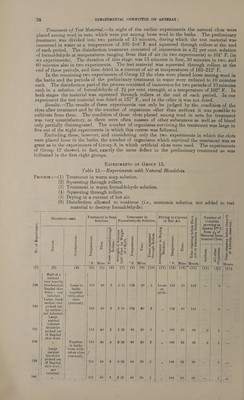
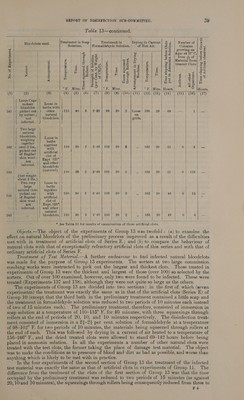
![Table 13—continued. } i | = F Q | 5 : am Blocdclots used. Treatment in Soap Treatment in Dryingin Current} 4 ¢ Number of | 2 ; P Solution. Formaldehyde Solution. of Hot Air. rs oe Colonies Ens fe eos eee 24 |) on ave Pee > | growing on > | ie Q70 P Es Pe: | i) Sa Agar at 37°C.) & a ane 2 |S% | ot Be $2 | from yy of | 38 2 | re my Bo lps at Ba 4 3 oo & Material from] — 4 A 5 = Pa cd (tae el ee 8 ag | treated Clots. 2 oa v 3 @cehe pa eOvads (i Tere Dasa 5 a= O21 ~ S| i q OD H bM, vray se a » oO 2 g n 5 3 & 2 #£ sSisen) 6/8 ie. 84/8] 8] F4 oy | 8 S$ 7 a E [SS igeo| 21 B [oh ss! a2)8)%e |] « | ee] eS 7, ‘ q 5) poeta 9 obi aS | Cen Sas BA? higea. fh TO cS | < c A ae EAR oer a F253 |8al|s p32 D gy ‘qs =| EE ba heated a ig Pom | x | eS OE Nei arn ° : | 3A n & ° | : | | | < < ro) ee. oh pe Me | F. |Mins,| & F. | Mins. < ° F. |Mins.| Hours. Hours. a) (2) @B) OO] @) M1 ®]| ®] G0] ad G2) G3) G4) | G5) | G6] ( Large Cape | ) ) mohair Loose in | bloodclot baths with 141 |4 picked out | > other S115 40: |. 33 2°29 98 20 2 |Loose | 166 23) 69 a 1 wr by sorters ; natural on | not bloodclots. grids, | | |. infected. | J J | Two large | } } . natural | bloodclots, | ton / ' weighing | | | baths | [)) togerber |). ether | . 142 |< over 3 lbs., ttre 110} 30; 2 | 2:49) 102} 20] 2 UTA LEQ 220! SMa 0 co || picked out | vials ! | | Ee Rasdad | artificial | | | | ae a ne r clot of _ |! | skin Wool || spt 121* aad | F tay 1 and other | | | | | aerree es . bloodclots | | 143 | Se eee A 10, f4-80,|-(2 in fitd-49, | 102) Qilch@icp rnc 162 |> 0b, 6 OAS fee | (but weight {| | | about 2 Ibs.) J J | | | | | Two very Loose in| ) | | large | baths | | | natural clots; | together | | 44 | picked out with 110.) 30) 2 | 2°40) 103) 20) 2 | 4, | 163) 20 48 0 13 | —- ‘| of Bagdad artificial ‘ . | | skin wool ; f clot of | { | laf not ' Expt. 123* / | | | infected. and other | natural 145 ne J bloodelots.)) 110 | 30] 2 | 2°40] 103 | 20] 2 eal LOS a) 320: 48 0 | Olio * See Table 11 for results of examination of these artificial clots. Objects.—-The object of the experiments of Group 13 was twofold: (a) to examine the effect on natural bloodclots of the preliminary process improved as a result of the difficulties met with in treatment of artificial clots of Series KE; and (b) to compare the behaviour of natural clots with that of exceptionally refractory artificial clots of this series and with that of ordinary artificial clots of Series F. . Treatment of Test Material.—A further endeavour to find infected natural bloodclots was made for the purpose of Group 13 experiments. The sorters at two large commission. combing works were instructed to pick out the largest and thickest clots. ‘I‘hose treated in experiments of Group 13 were the thickest and largest of those (over 100) so selected by the sorters. Out of over 100 examined, however, only two were found to be infected.. These were treated (Experiments 137 and 138), although they were not quite so large as the others. The experiments of Group 13 are divided into two sections: in the first of which (seven experiments) the treatment was exactly the same as in that of the artificial clots (Series E) of Group 10 (except that the third bath in the preliminary treatment contained a little soap and the treatment in formaldehyde solution was reduced to two periods of 10 minutes each instead of two of 15 minutes each). The preliminary treatment, therefore, consisted of immersion in soap solution at a temperature of 110-115° F. for 40 minutes, with three squeezings through rollers at the end of periods of 20, 10, and 10 minutes respectively. The disinfection treat- ment consisted of immersion in a 24-23 per cent. solution of formaldehyde at a temperature of 98-102° F. for two periods of 10 minutes, the materials being squeezed through rollers at the end of each. This was followed by drying in a current of air heated to a temperature of 156-166° F., and the dried treated clots were allowed to stand 69-142 hours before being placed in ammonia solution. In all the experiments a number of other natural clots were treated with the test clots, the former taking the place of damage test material. The object was to make the conditions as to presence of blood and dirt as bad as possible, and worse than anything which is likely to be met with in practice. In the four experiments of the second section of Group 13 the treatment of the infected test material was exactly the same as that of artificial clots in experiments of Group 11. The difference from the treatment of the clots of the first section of Group 13 was that the time occupied by the preliminary treatment was reduced to two periods of 15 minutes (as against 20,10 and 10 minutes), the squeezings through rollers being consequently reduced from three to](https://iiif.wellcomecollection.org/image/b32178049_0047.jp2/full/800%2C/0/default.jpg)