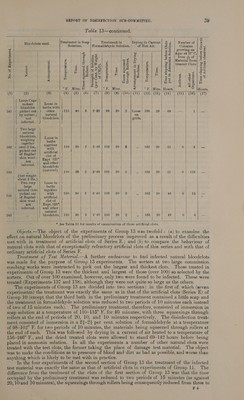
Report of the Departmental Committee apointed to inquire as to precautions for preventing danger of infection from anthrax in the manipulation of wool, goat hair, and camel hair.
- Great Britain. Committee on Anthrax.
- Date:
- 1918
Licence: Public Domain Mark
Credit: Report of the Departmental Committee apointed to inquire as to precautions for preventing danger of infection from anthrax in the manipulation of wool, goat hair, and camel hair. Source: Wellcome Collection.
48/356 page 40
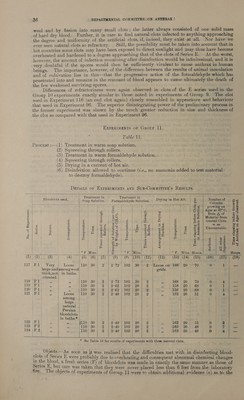
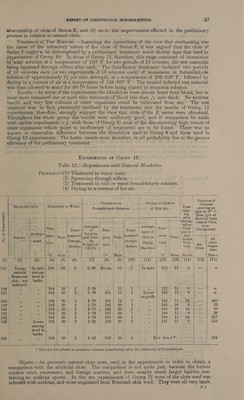
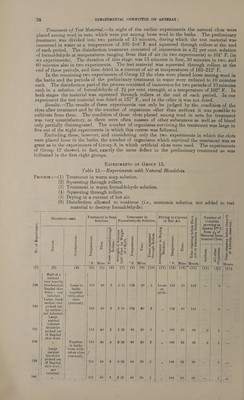
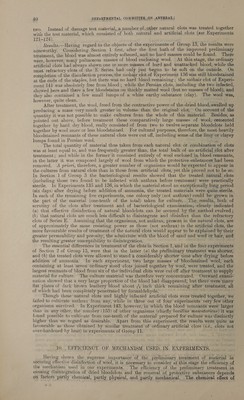
![two. Instead of damage test material, a number of.,other natural clots was treated together with the test material, which consisted of both natural and artificial clots (see Experiments 121-124). | ees | | | Results —Having regard to the objects of the experiments of Group 13, the results were noteworthy. Considering Section 1 first, after the first bath of the improved preliminary treatment, the blood was almost entirely softened, and-no hard masses could be found. There were, however, many pultaceous masses of blood enclosing wool. At this stage, the ordinary artificial clots had always shown one or more masses of hard and unattacked blood, while the most refractory clots of the E Series had only just begun ‘to be soft on the outside. On completion of the disinfection process, the mohair clot of Experiment 136 was still bloodstained at the énds of the staples, but there was no hard blood: remaining; the mohair clot of Experi- ment 141: was absolutely free from blood ; while the Persian clots, including the two infected, showed here and there a few bloodstains on thickly matted wool (but no masses of blood), and they also contained a few small lumps of a white earthy substance (clay). The wool was, however, quite clean. | x, er cide After treatment, the wool, freed from the contractive power of the dried blood; swelled up producing a mass very much greater in volume than the original clot. On account of the quantity it was not possible to make cultures from the whole of this material. Besides, as pointed out above, before treatment these comparatively large masses of wool, cemented together by hard dry blood, really consisted of from two to twelve separate bloodclots held together by wool more or less bloodstained. J'or cultural purposes, therefore, the most heavily bloodstained remnants of these natural clots were cut off, including some of the limy or clayey lumps found in Persian wool. eet The total quantity of material thus taken from each natural clot: or combination of clots was at least equal to, and was frequently greater than, the total bulk of an.artificial clot after treatment; and while in the former it consisted entirely of wool enclosed in. blood remnants, in the latter it was composed largely of wool from which the protective substances had been removed. A priori, therefore, a greater number of organisms would be expected to appear in the cultures from natural clots than in those from artificial clots, yet this proved not to be so. In Section 1 of Group 3 the bacteriological results showed that the treated natural .clots (including those two found to be infected with anthrax before treatment) were practically sterile. In Experiments 135 and 136, in which the material stood an exceptionally long period (six days) after drying before addition of ammonia, the treated materials were quite sterile. In each of the remaining five experiments, one colony only (not anthrax) could be grown in the part of the material (one-tenth of the total) taken for culture. The results, both of scrutiny of the clots after treatment and of bacteriological examination; clearly indicated (a) that effective disinfection of natural bloodclots can be secured by the method evolved ; (b) that natural clots are much less difficult to disintegrate and disinfect than the refractory clots of Series E. Assuming that the organisms, not anthrax, present in the natural clots, are of approximately the same resisting power as those (not anthrax) in the artificial clots, the more favourable results of treatment of the natural clots would appear to be explained by their greater permeability and porosity, the admixture with the blood of sand and wool or hair, and the resulting greater susceptibility to disintegration. ; ia ois: ee The essential differences in treatment of the clots in Section 1, and in the four experiments of Section 2 of Group 13, were that in the latter (a) the preliminary treatment was shorter, and (b) the treated clots were allowed to stand a considerably shorter time after drying before addition of ammonia. In each experiment, two large masses of bloodstained wool, each containing at least seven ordinary sized clots joined together by wool, were treated, and the largest remnants of blood from six of the individual clots were cut off after treatment to supply material for culture. The culture material was therefore very concentrated. Outward exami+ nation showed that a very large proportion of the blood had disappeared, but there were many flat plates of dark brown leathery blood about 7's inch thick remaining after treatment, all of which had been completely penetrated by formaldehyde, atts lpliaciateh ego ace, Though these natural clots and highly infected artificial clots were treated together, we jailed to cultivate anthrax from any, while in three out of four experiments very few other organisms survived. In Experiment 143, however, in which the blood remnants weré larger than in any other, the number (153) of other organisms (chiefly bacillus mesentertcus) it was found possible to cultivate from one-tenth of the materia] prepared for culture was distinctly higher than we regard as desirable. ‘Apart from this experiment, the results were quite as favourable as those obtained by similar treatment of ordinary artificial clots (7.e., clots not over-hardened by heat) in‘experiments of Group 11. Mit 4M winae Wo bape 10, EFFICIENCY. OF MECHANISM USED. IN. EXPERIMENTS. | | niga: Having shown the supreme importance of the. preliminary treatment of material in securing effective disinfection of wool, it is necessary to consider at this stage the efficiency of the mechanism used in our experiments. The efficiency of the preliminary treatment in causing disintegration of dried bloodclots and the removal of protective substances depends on factors partly chemical, partly physical, and partly mechanical. The chemical effect of](https://iiif.wellcomecollection.org/image/b32178049_0048.jp2/full/800%2C/0/default.jpg)